Americans aren’t expecting a wave of pink slips, but they’re becoming less confident about what would happen if they needed another job.
The Federal Reserve Bank of New York’s August Survey of Consumer Expectations found that the mean probability consumers assign to unemployment being higher a year from now rose 1.6 percentage points to 44.4%. The latest figure marked the highest reading since April 2020, and the increase spanned age, education and income groups.
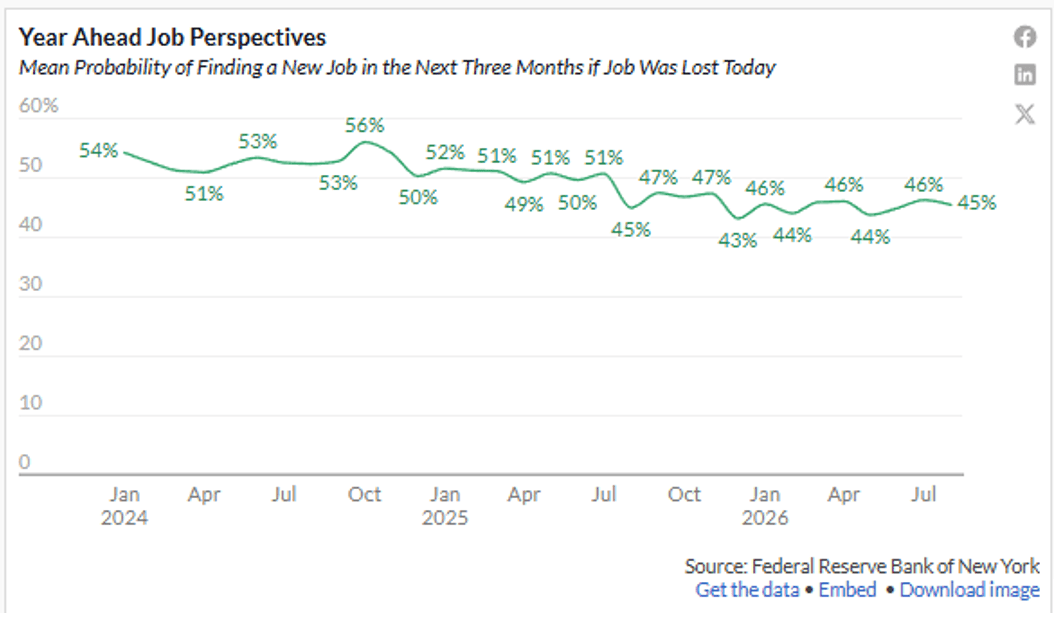
At the same time, the perceived probability of finding another job after losing one declined 0.8 percentage point to 45.4%, just below its 12-month average of 45.5%. There’s a bit of paradox in the mix, as consumers’ perceived probability of losing their current job actually declined to 13.8%, the lowest since February, while the expected voluntary quit rate rose to 19.5%. The read across is that folks feel somewhat safer in the jobs they have while expressing more concern about the labor market outside their current employers.
For household spending, the availability of another job can affect how much risk consumers are willing to take with the income they have now. A worker who expects another paycheck to be readily available after a layoff has more financial latitude than one who expects a prolonged job search.
Income expectations, as detailed by the Fed, provide little indication that households expect substantially more money to offset that risk. Median expected household income growth remained at 3.0% in August and has stayed within a range of 2.8% to 3.0% since June 2025. Expected earnings growth edged up 0.1 percentage point to 2.9%.
Expected household spending growth, however, rose 0.3 percentage point to 5.2%. The findings from the central bank do show consumers expecting spending to keep growing while their outlook for household income has changed little.
PYMNTS Intelligence data show how little room some households have if employment income is interrupted.
We’d love to be your preferred source for news.
Please add us to your preferred sources list so our news, data and interviews show up in your feed. Thanks!
Savings Put a Clock on a Job Search
The August PYMNTS Consumer Expectations Index found 19% of households said their financial lifestyle had deteriorated over the previous year, compared with 7.1% that said it had improved. The share living paycheck to paycheck and struggling to pay bills rose from 18% to 27%.
Income played a substantial role in which households lost ground. Household income had fallen for 33% of consumers whose financial circumstances deteriorated, compared with 21% of those whose circumstances remained stable. Among households whose bills became easier to manage, 44% cited higher household income.
Savings determine how long a household can operate without replacing lost earnings. Just 26% of households whose financial position deteriorated said they could cover more than three months of expenses from savings. The corresponding shares were 46% among households whose position remained stable and 62% among those whose finances improved.
A more difficult job search can shorten the period before a household has to reduce purchases, draw down savings or borrow. The exposure is greater among consumers already having trouble with monthly bills.
The New York Fed found evidence of pressure on the credit side as well. The average perceived probability of missing a minimum debt payment during the next three months rose 1.2 percentage points to 13.2%, slightly above its 12-month average. More consumers said credit was harder to obtain than a year earlier, and expectations for credit availability over the next year deteriorated.
Inflation hasn’t disappeared from the household calculation. Median one-year inflation expectations remained at 3.6% in August, while five-year expectations held at 3.0%. Three-year expectations declined 0.1 percentage point to 3.2%. Consumers expected higher price growth for gas, food, medical care, college education and rent.
PYMNTS Intelligence found that 28% of households encountered an unexpected expense of at least $1,200 during the previous 90 days. Among consumers living paycheck to paycheck and struggling to pay bills, 35% carried their largest such expense on a credit card balance, 27% borrowed from family or friends and 21% skipped or delayed another bill.
The labor market numbers add another variable to those household finances. Consumers don’t have to expect an imminent layoff for weaker job prospects to affect their behavior. If another paycheck looks harder to secure, maintaining savings and limiting new financial obligations can become more valuable, particularly for households that already have only a few months of expenses available in cash.



 Add as Preferred Source