Robot factories have been a next-generation manufacturing narrative since before color TV.
It’s a simple vision of the future: machines replace workers and manufacturing sites become “dark factories,” operating without lights because no human workers would be present. But that future never arrived, and it has certainly had enough time and technology to do so.
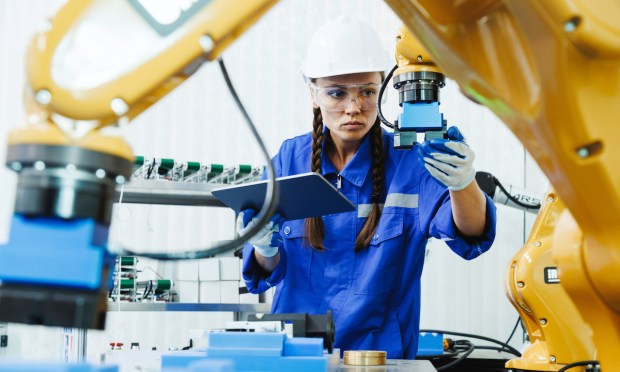
Instead, as headlines this week around General Motor’s expanding use of collaborative robots and Nvidia’s new robotics safety platform highlight, a new phase of industrial automation is emerging in which collaborative robots, artificial intelligence (AI) systems and humans are expected to operate side by side in “dim,” not “dark,” factories.
GM is expanding its deployment of collaborative robots at Factory Zero, its flagship electric vehicle manufacturing facility, while Nvidia on Monday (June 22) introduced Halos, a comprehensive safety platform designed to make humanoid robots safer when operating alongside human workers. Taken together, these moves reflect a broader shift where the challenge in smart manufacturing is no longer whether machines can perform physical work but whether they can do so safely, reliably and economically alongside people at scale.
The new limiting factor in a factory being re-designed around humans, collaborative robots, autonomous systems, AI agents and eventually humanoid robots operating within the same environment is no longer robotic capabilities but trust. And not just trust between individual workers, but trust in the overall system itself.
See also: Bezos’s AI Manufacturing Gamble Could Change How Companies Get Fixed
System-Level Trust is the Smart Factory’s Next Physical AI Challenge
For much of the past two decades, advances in robotics focused primarily on capability. Industrial robots became faster, stronger and more precise. Machine vision improved while AI systems became more adept at identifying objects, planning movements and optimizing production processes.
Collaborative robots, or cobots, represent a fundamentally different approach. They are designed to share workspaces with people, assisting with repetitive, physically demanding or precision-oriented tasks while allowing human workers to handle judgment-intensive activities.
This shift dramatically expands the potential applications of automation but also introduces an entirely new category of risk. Can autonomous systems safely operate near people? Can AI-powered machines reliably interpret their surroundings? Can manufacturers certify that intelligent systems will behave predictably under real-world conditions?
We’d love to be your preferred source for news.
Please add us to your preferred sources list so our news, data and interviews show up in your feed. Thanks!
Those questions may determine the pace of industrial automation more than advances in robotics hardware itself. In a traditional industrial setting, safety is achieved through distance. In a collaborative environment, safety must be engineered into every interaction. Robots must recognize people, anticipate movement, understand context and react appropriately to unexpected situations.
The challenge bears similarities to the broader deployment of AI across industries. Whether in healthcare, financial services, transportation or manufacturing, organizations increasingly trust AI systems with critical tasks. But bolt-on capability alone is insufficient. Success depends not only on making machines smarter but also on proving they can operate safely and reliably under countless real-world conditions.
“We have to reimagine the way work needs to be done, which requires a cultural transformation with AI,” Charbel Safadi, CEO of Zafin, said in a recent PYMNTS exclusive interview on the need for enterprise AI orchestration. “Many organizations think the solution is adding tools to the human capacity, but not reinventing the way actual work is done across an enterprise.”
See also: CES Spotlights B2B Tech Driving Next Industrial Era
Smarter Manufacturing Makes US Reshoring Economically Plausible
The emergence of collaborative robotics also challenges long-standing assumptions about automation and employment. Many manufacturing jobs are difficult to fill, particularly in developed economies facing labor shortages and aging workforces. At the same time, increasing product complexity requires greater flexibility than traditional automation systems can easily provide.
But the most underappreciated aspect may be around reshoring U.S. manufacturing. Over time, labor cost advantages drove manufacturing capacity toward lower-cost regions. Producing goods overseas often remained economically attractive despite shipping expenses, supply chain complexity and geopolitical risks. But those same complexities are becoming unavoidable in today’s macro landscape. And after years of supply-chain disruptions, geopolitical tensions and rising concerns about industrial resilience, reshoring has become one of the defining themes of modern manufacturing strategy.
But the most important manufacturing story may not be about bringing jobs back at all.
It may be about bringing production back. That distinction is becoming more significant as automation technologies mature and the economics of manufacturing evolve. The factories being built today are being designed around labor scarcity. They assume a world in which workers are harder to find, more expensive to recruit and more focused on higher-value tasks rather than repetitive production work.
The combination of collaborative robotics, AI-driven optimization and sophisticated safety systems creates conditions that make domestic manufacturing more competitive than it has been in decades. The factories emerging today reflect that reality. They are not the dark factories imagined a generation ago. They are dimly lit, densely connected environments where humans and intelligent machines collaborate continuously.


 Add as Preferred Source