“How Acquirers Prepare for Agentic Commerce” offers a more grounding take. The PYMNTS Intelligence report, commissioned by Visa Acceptance Solutions, finds that agentic commerce is not a new stack. It is a new channel running on an existing one.
That distinction matters because it reframes the challenge. Success may not depend on building new payment rails. The real question is whether existing systems can keep up. Authentication systems, fraud models and orchestration layers must all stretch to support a new kind of actor.
AI agents browsing, deciding and transacting on behalf of consumers are less a transformation story. They represent unfinished work inside existing payment infrastructure.
Acquirers sit between merchants and payment networks. For them, agentic commerce extends a decade-long push toward omnichannel commerce. The same systems built to unify in-store, online and mobile experiences must now handle software-initiated transactions.
The difference is not conceptual but operational. That’s where the friction lies.
Agentic Commerce Runs on Existing Infrastructure, Not New Payment Rails
For acquirers, the challenge is less about enabling transactions and more about governing them. Identity verification, credential security and fraud prevention are already complex in omnichannel environments. They become more ambiguous when software makes decisions on a user’s behalf.
A fragmented infrastructure that struggles to reconcile online and offline transactions is even less equipped to handle agent-initiated payments. The result is a compounding effect. The limits of yesterday’s systems become the barriers to tomorrow’s innovation.
Agentic commerce is a systems-and-trust-layer problem, not a product problem. The report found that the industry agrees. Over 9 in 10 acquirers cited governance and permissions, consent and data frameworks, fulfillment orchestration and cross-business coordination as their top agentic priorities.
We’d love to be your preferred source for news.
Please add us to your preferred sources list so our news, data and interviews show up in your feed. Thanks!
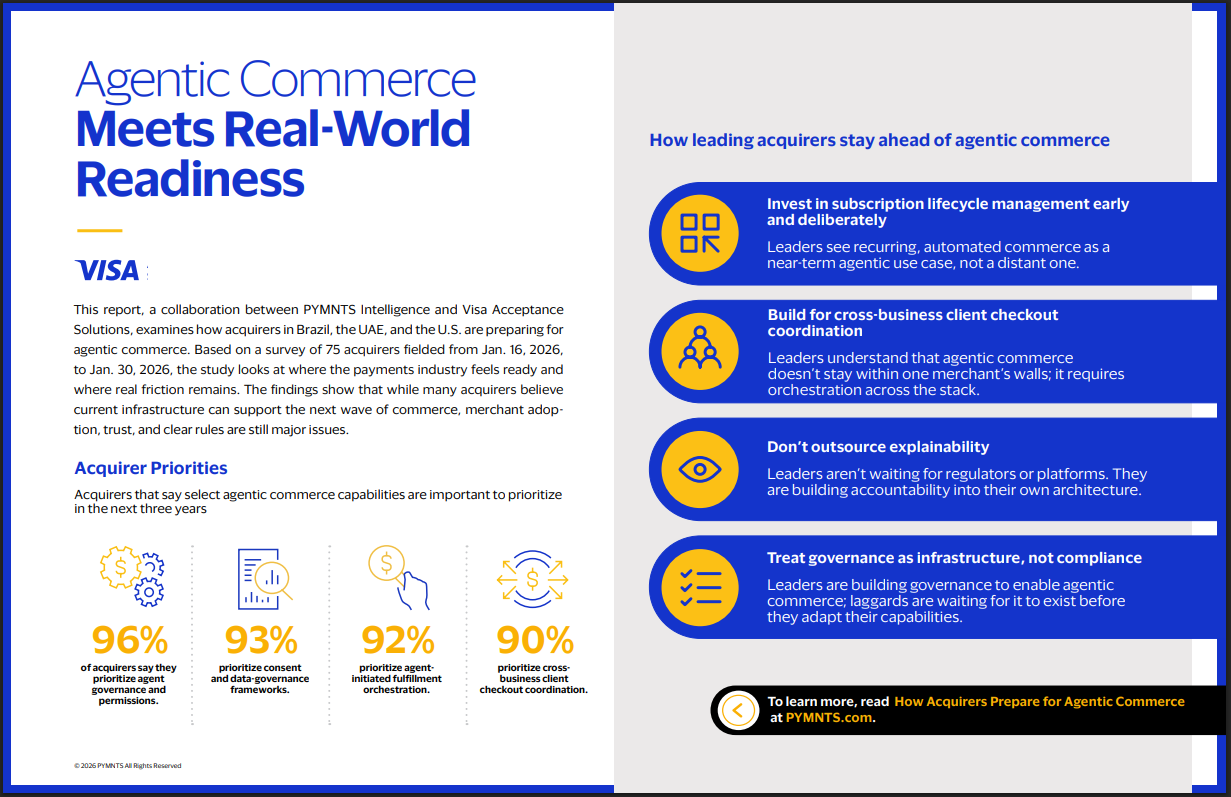
What acquirers did not prioritize is equally telling. Flashy AI capabilities, new payment methods and consumer UX innovation did not move the needle in agentic preparation.
The limiting factor is not computational power. It is governance. Systems can act. The question is whether institutions are ready to oversee that action.
Read the report: How Acquirers Prepare for Agentic Commerce
Acquirers That Build Governance Frameworks Now Will Define Agentic Commerce
Early investments in agentic commerce focus not on automation but on guardrails. Explainability tools, monitoring systems and reversible transaction features are drawing more investment than fully autonomous execution. The goal is not to maximize what agents can do. It is to ensure that what they do can be understood, controlled and undone if needed.
The hesitation across much of the industry also creates space to stand out. Early movers on infrastructure and governance can shape agentic commerce, not just participate in it. Those that invest in modernizing risk models and building governance frameworks can become architects of the category.
Agentic commerce may not be the revolution it is sometimes portrayed as. But it is a test of infrastructure, coordination and strategic intent. In past payment transitions, results went to those who built the underlying systems. Seeing the future first was never enough.
The challenges are real and the outcomes uncertain. But the history of payments suggests that companies shaping the underlying systems capture the most value.
At PYMNTS Intelligence, we work with businesses to uncover insights that fuel intelligent, data-driven discussions on changing customer expectations, a more connected economy and the strategic shifts necessary to achieve outcomes. With rigorous research methodologies and unwavering commitment to objective quality, we offer trusted data to grow your business. As our partner, you’ll have access to our diverse team of PhDs, researchers, data analysts, number crunchers, subject matter veterans and editorial experts.



 Add as Preferred Source