Agentic artificial intelligence is scaling toward a digital commerce landscape where AI agents will buy things for people.
That means fewer humans browsing storefronts, comparing products, entering card numbers, clicking checkout buttons, and it could reshape the infrastructure layer of commerce.
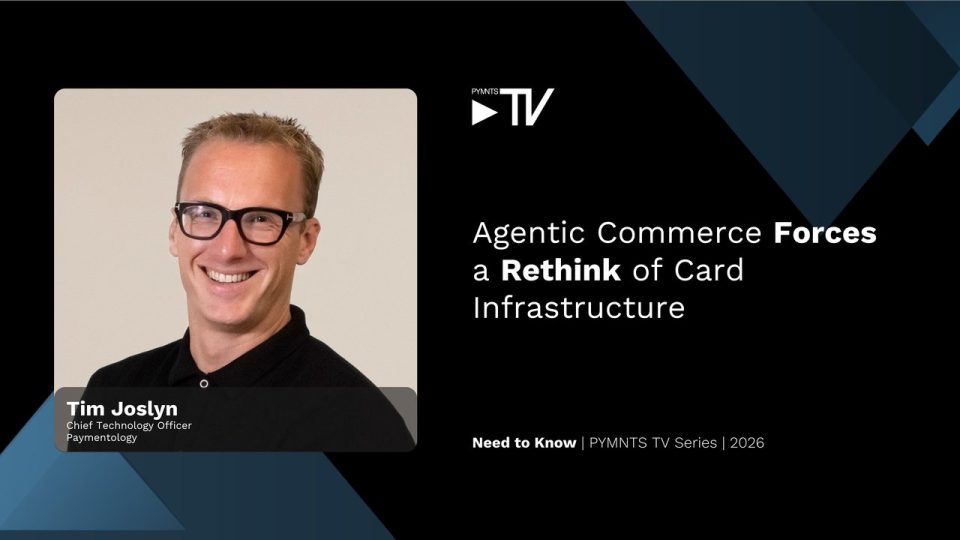
“We’ve been seeing machine-to-machine payments for years, whether it’s automated billing or cloud billing, API consumption models, things like that,” Tim Joslyn, chief technology officer at Paymentology, told PYMNTS. “What’s changing now is that AI is the one effectively making the decision.”
The deeper implication is that agentic AI could spur a shift in commerce power away from whoever owns the storefront and toward whoever owns the decision layer.
“It’s easy to get something to recommend you a product,” Joslyn said. “But the hard part is allowing it to spend your money.”
That distinction matters. The infrastructure capable of moving money autonomously already exists. What is emerging now is a layer of AI-driven decision-making that sits before the payment itself and determines whether an AI agent should be trusted to spend money in the first place, under what conditions and with what degree of delegated authority.
Read also: Agentic Commerce Forces a Rethink of Card Infrastructure
Commerce Is Moving From Human Speed to Machine Speed
For years, FinTech innovation focused on reducing friction at checkout. But autonomous commerce introduces a different challenge entirely, one that is forcing commerce infrastructure to evolve from transaction processing into continuous trust management.
“The payment rails themselves are very adaptable,” Joslyn said. “Probably 99% of the issuer processing systems out in the world could process an agentic payment.”
“The issue becomes whether you’ve recognized the transaction as an agent payment, and whether you’ve put the right identity and trust frameworks around it,” he added.
The strategic battleground, as a result, is shifting upward into orchestration systems capable of handling machine identity, contextual permissions, real-time authorization controls and behavioral governance. The companies that build these systems may ultimately hold more long-term leverage than the companies building consumer-facing AI shopping interfaces.
“The real value is going to be created around things like orchestration and programmable controls,” Joslyn said, adding that the idea that agentic commerce technologies will inevitably threaten incumbent payment schemes is a misplaced one.
“The biggest thing to remember about the networks is they already have global acceptance,” he said. “They also have the trust infrastructure in place. There is a set of rules that allows you to clearly understand when something can be charged back or who’s liable at what point.”
That existing trust infrastructure will likely prove crucial in supporting future agentic commerce ecosystems. The market is already moving beyond theory to deployment. Joslyn pointed to Alipay’s rollout of delegated AI purchasing capabilities, which allow users to authorize AI agents to complete purchases on their behalf.
“People are getting into actual delegated spending authority,” Joslyn said, adding that the platform had surpassed 100 million users. “The idea of using a card in an eCommerce world could become largely alien.”
We’d love to be your preferred source for news.
Please add us to your preferred sources list so our news, data and interviews show up in your feed. Thanks!
The Rise of the Intent Economy
Strong agentic use cases are already emerging in operationally dense environments such as travel coordination, subscription management, procurement, treasury optimization and embedded financial services. Still, the most viable applications of agentic commerce today are unlikely to involve fully autonomous shopping, and not every industry will adopt autonomous commerce equally.
Sectors combining payments, identity, contextual data, orchestration and dynamic optimization are most likely to see early acceleration, Joslyn said.
“You have dynamic decision-making, multiple counterparties, real-time optimization, cross-platform coordination,” he said. “That becomes your perfect storm. Some kind of orchestration needs to happen, with authorization.”
In an environment like the travel space, for example, AI agents can compare itineraries, negotiate pricing, manage loyalty rewards, rebook disruptions, coordinate approvals and execute payments autonomously. The common denominator is cognitive burden. Consumers and businesses increasingly operate within systems too complex to manage manually. AI agents become economically valuable because they absorb coordination costs and operational decision-making at scale.
Still, AI agents behave nothing like humans, and one of the biggest blind spots in discussions around agentic commerce is fraud prevention.
“We’re moving from human-speed fraud to machine-speed fraud,” Joslyn said.
That transition fundamentally alters how risk must be modeled. Continuous autonomous activity means fraud systems can no longer assume natural human limitations like sleep cycles, behavioral consistency or cognitive friction.
Longer term, Joslyn said he expects operational commerce to become increasingly invisible.
Within three years, AI agents may autonomously manage procurement, optimize treasury functions, negotiate services and coordinate recurring operational spending with minimal human oversight.
“Agentic commerce has stopped being a fantasy,” Joslyn said. “It’s not a ‘Will this happen?’ It’s now a ‘How do we do it, and how do we scale it safely?’”
See the full interview: Need to Know, With Paymentology’s Tim Joslyn
For all PYMNTS AI coverage, subscribe to the daily AI Newsletter.


 Add as Preferred Source