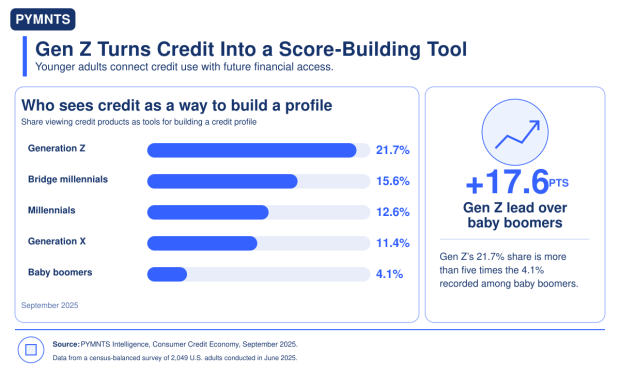
For younger consumers, credit is increasingly a ladder: 21.7% of Gen Z consumers view credit products as tools for building a credit profile, 17.6 percentage points more than baby boomers.
That generational divide is one of the clearest signals in “Consumer Credit Economy: Strategy vs. Spontaneity, Navigating the Great Credit Divide,” a PYMNTS Intelligence report. Based on a census-balanced survey of 2,049 U.S. adults conducted in June 2025, the report finds consumers often underestimate their approval odds, use credit for both planned and unexpected purchases and want more control over how their products work. One of its key findings points to a constructive goal behind demand: Many consumers want credit to help them establish a stronger credit position.
We’d love to be your preferred source for news.
Please add us to your preferred sources list so our news, data and interviews show up in your feed. Thanks!
Key Points:
- Credit cards lead the way. Among consumers who don’t have an active credit card but want one, 26.2% name building or improving their credit score as their top reason for applying. That ranks ahead of emergency funds at 19.1% and everyday expenses at 9.5%.
- The motivation extends beyond cards. Building credit is the leading reason 16% of interested consumers without an active buy now, pay later account would open one. It also draws 10% of consumers interested in payday loans and 7.2% of those interested in mortgages.
- Age changes the strategy. Gen Z’s 21.7% share is more than five times the 4.1% recorded among baby boomers. Bridge millennials follow at 15.6%, while millennials stand at 12.6% and Generation X at 11.4%. Younger adults may see credit less as a finished financial tool and more as a way to create future options.
The findings give banks, issuers and FinTechs an opportunity to explain how responsible credit use can support long-term financial health. That education could also narrow another gap in the report. While 42% of consumers doubt they would be approved for a new card, the actual denial rate among consumers without one is 15%. The report also finds that 53% of recent credit users made only or mostly planned purchases.
Meanwhile, 59% express interest in a card that lets them choose each month between rewards and a lower interest rate. Clearer approval information, credit-building guidance and flexible features could help consumers approach borrowing with more confidence and a plan.
For providers, the opportunity is to connect product features with the progress consumers want to make, while giving them realistic information about costs, approval chances and repayment. For consumers, that can turn uncertainty into a more informed choice.


 Add as Preferred Source