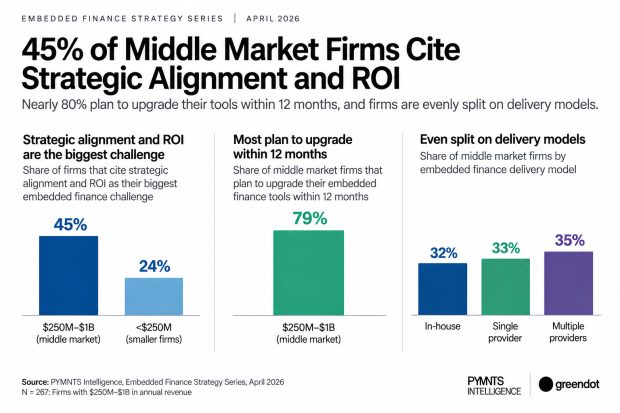
Middle market companies are the most active embedded finance upgraders, but they also report the greatest difficulty connecting those investments to business strategy. Among firms with $250 million to $1 billion in annual revenue, 45% cite strategic alignment, decision making and return on investment as an obstacle, compared with 24% of firms below $250 million.
The finding puts the middle market at a particular point in embedded finance adoption. “The Embedded Finance Scale Factor: How Firm Size Shapes Strategy, Technology and Partnership Decisions,” produced by PYMNTS Intelligence in collaboration with Green Dot, surveyed 515 senior leaders at U.S. companies. Nearly 4 in 5 middle market firms plan to upgrade their embedded finance capabilities within 12 months.
We’d love to be your preferred source for news.
Please add us to your preferred sources list so our news, data and interviews show up in your feed. Thanks!
Delivery models remain unsettled in the middle market. Firms in the $250 million to $1 billion revenue tier are almost evenly divided among building embedded finance in-house, relying on one external provider and using multiple third parties. Thirty-two percent operate in-house, 33% use a single provider and 35% use multiple providers. By comparison, 54% of firms with more than $1 billion in revenue rely on a single external provider. The middle market numbers show no dominant operating model has emerged for this cohort.
Upgrade activity is high even as operating models vary. Seventy-nine percent of middle market firms plan to upgrade embedded finance within 12 months, nearly matching the 80% rate among firms below $250 million and well above the 63% rate among firms with more than $1 billion in revenue. Only 3% of middle market firms report no plans to enhance their capabilities, versus 19% of the largest firms.
Partner requirements also change at this stage. Thirty-two percent of middle market firms say an embedded finance partner must hold a bank charter, the highest rate among the three revenue groups. The report says smaller firms put more emphasis on provider trust and data security, while larger firms place more weight on customization and fit with existing business operations.
For providers, the data describes a market in which demand for new capabilities does not necessarily mean a company has settled how those capabilities should be delivered. Middle market firms are upgrading quickly while dividing their operations among in-house, single-provider and multi-provider models. Their elevated concern about strategic alignment and ROI makes the business case, operating model, and partner structure part of the same implementation decision.
At PYMNTS Intelligence, we work with businesses to uncover insights that fuel intelligent, data-driven discussions on changing customer expectations, a more connected economy and the strategic shifts necessary to achieve outcomes. With rigorous research methodologies and unwavering commitment to objective quality, we offer trusted data to grow your business. As our partner, you’ll have access to our diverse team of PhDs, researchers, data analysts, number crunchers, subject matter veterans and editorial experts.


 Add as Preferred Source