Artificial intelligence’s near-term payments value may come less from autonomous checkout than from making the payment stack itself more intelligent and machine-readable.
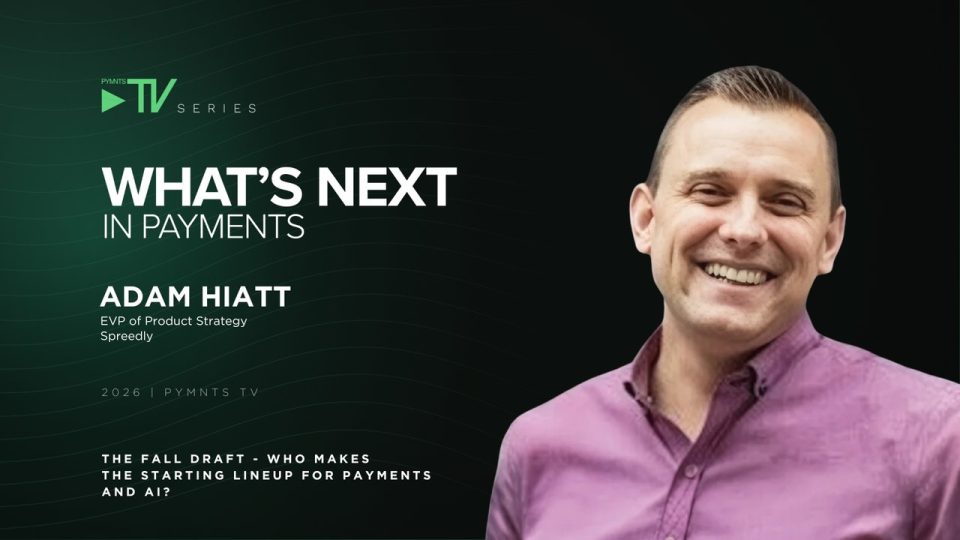
“There’s a ton of payments optimization potential in these payments rails, particularly in complex multi-PSP [payment service provider] environments,” Adam Hiatt, executive vice president of product strategy at Spreedly, told PYMNTS for the September “What’s Next in Payments Series: The Fall Draft.”
While the industry races to build AI agents that can search, recommend and eventually buy, a separate opportunity is emerging inside the payment stack itself around making complex processor environments easier to manage and eventually determining which software agents should be trusted to transact at all.
Hiatt sees the market splitting into two tracks. On the consumer side, agentic behavior is already gaining traction in verticals such as travel, where people are using large language models to plan and narrow purchasing decisions. On the infrastructure side, AI is starting to attack a much older problem: payments systems generate more data than most organizations can consistently turn into action.
“The technologies that we’re seeing today are actually able to be that lever, to start taking advantage of all of that data and drive both insights and eventually cost savings and efficiencies out of it,” Hiatt said.
AI Could Turn Payments Infrastructure From an Asset Into Technical Debt
Despite the excitement surrounding it, the near-term agentic commerce opportunity is unlikely to develop evenly across categories.
“In the hospitality, travel and to a secondary extent within the DTC [direct to customer] retail space, the demand is starting to pick up from the actual real customers, the end consumers,” Hiatt said, pointing to growing use of large language models (LLMs) for trip planning and booking. He said “somewhere around 40% of all travelers were using LLMs to plan or book” by the end of 2025.
That suggests the first agentic commerce winners may not be the merchants with the most sophisticated AI checkout experience. They may be the ones whose inventory can be found, interpreted and surfaced inside AI-native discovery environments. In effect, the funnel is already moving before the transaction does.
Still, the more overlooked opportunity sits deeper in the stack.
“The intelligence, payments intelligence piece of the story around the AI enablement” is where Hiatt sees substantial upside. If AI can translate processor performance into recommendations that finance, product and operations teams can understand, payments intelligence stops being a specialist function and becomes an enterprise decision layer.
For large merchants and platforms, payments infrastructure often spans multiple PSPs, processors, geographies and payment methods. Each layer produces data on authorization rates, routing performance, costs and fraud. The challenge is turning that data into decisions quickly enough to improve outcomes, but AI could change the economics of that complexity by making optimization continuous rather than periodic.
AI Discoverability Is Becoming a Revenue Driver
For merchants, Hiatt’s most immediate recommendation is not to deploy autonomous checkout. It is to fix the catalog. Search engine optimization trained merchants to make webpages legible to algorithms. Agentic commerce requires something similar at the product and inventory level.
“If the SKUs aren’t available and findable, nothing else matters,” Hiatt said.
That sounds tactical, but the implication is strategic. As product discovery shifts toward conversational and AI-driven interfaces, structured product data becomes part of distribution.
We’d love to be your preferred source for news.
Please add us to your preferred sources list so our news, data and interviews show up in your feed. Thanks!
Hiatt cited one entertainment sector customer where AI-originated sessions “convert and are complete at roughly two to three times the number of the sessions that start in traditional search.”
If that performance holds more broadly, AI discoverability becomes less a future-commerce experiment than a current revenue optimization problem. After all, not every visible AI feature is producing the same results.
“The onsite chat-based buying experience I think has gotten a lot more hype than it probably deserves,” Hiatt said, noting that a chatbot inserted into an already functional buying journey may simply create another interface layer without solving a meaningful problem.
In some cases, it can underperform the conventional funnel it was supposed to replace.
Payments Must Learn to Authenticate Machines
The harder problem arrives once AI agents move from recommendation to execution. Payment systems have spent decades building controls around human identity. Agentic commerce introduces a different challenge: determining whether a machine is legitimate, what authority it has and whether the action it takes reflects the consumer’s intent.
“When you bring in nonhuman actors, it’s going to change the landscape, or is changing the landscape really dramatically,” Hiatt said, adding that, historically, automated behavior inside a payments flow was easier to classify.
But if a consumer authorizes an agent, the agent makes the wrong purchase and the consumer disputes the transaction, the existing framework becomes messy quickly. The merchant may have done nothing wrong. The customer may genuinely feel harmed. The agent may have technically operated within a permission it interpreted incorrectly.
“There are good bots and there are bad bots,” Hiatt said. “And so, KYA, the know your agents model, that idea as a business is a new category.”
That is not simply a fraud problem. It is an authorization and accountability problem. And it may prove more important to agentic commerce than checkout itself.
Watch the full PYMNTS TV interview with Adam Hiatt to hear more about:
- Why the biggest AI opportunity in payments may sit below the checkout. Hiatt says AI can turn the enormous data generated by multi-PSP payment stacks into routing, cost and performance decisions — making payments intelligence useful beyond specialized payments teams.
- Why merchants should optimize for AI discovery before autonomous buying. Hiatt says product catalogs and SKUs need to become findable by agents now, pointing to one entertainment company where AI-search sessions converted at roughly two to three times the rate of traditional-search sessions.
- Why payments needs to learn the difference between “good bots and bad bots.” Hiatt says agent identity and authorization are becoming a new infrastructure category, as payment systems confront unresolved questions around consumer intent, fraud, chargebacks and liability when software transacts on a person’s behalf.
For all PYMNTS AI coverage, subscribe to the daily AI Newsletter.

 Add as Preferred Source