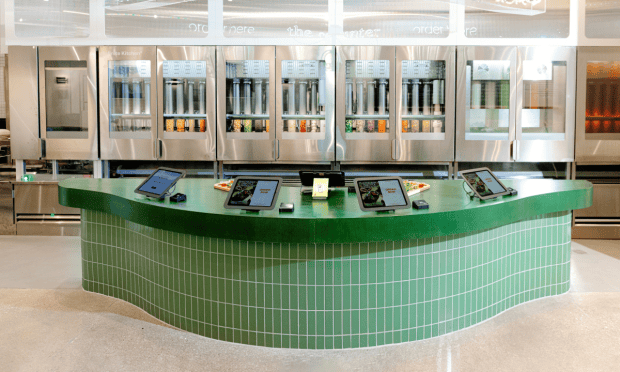
One machine can make 500 burrito bowls, salads and poke bowls an hour. A human worker makes roughly 30 to 45. That gap is the business case Marc Lore is building Wonder around. Fortune reported that Lore unveiled the system recently. A turntable spins each bowl on a while ingredients drop in according to the customer’s order. Lore said it produces no errors.
Wonder paid $186.4 million to acquire the technology from Sweetgreen in December. Bloomberg reported the deal transfers Sweetgreen’s Infinite Kitchen automation business to Wonder, with Sweetgreen continuing to operate the system across its own locations under a supply agreement. Restaurant Dive reported that the technology is already live in more than 20 Sweetgreen locations. Wonder plans to test it in a Manhattan location this year, with Restaurant Business reporting that 50 to 100 installations are planned across Wonder kitchens in 2027.
Labor Costs Drive Automation
We’d love to be your preferred source for news.
Please add us to your preferred sources list so our news, data and interviews show up in your feed. Thanks!
Labor is the biggest cost pressure in food service. Full-service restaurants now run labor at a median of 36.5% of sales, the National Restaurant Association found. Only 42% of U.S. restaurants were profitable in 2024. Minimum wages are rising across 22 states in 2026. Every percentage point saved on labor goes straight to the bottom line.
Restaurant workflows suit automation in ways that most industries don’t. The tasks are structured, repetitive and measurable. The same bowl gets made the same way thousands of times a day. There’s no unpredictable terrain for a machine to navigate. There’s no judgment call required. That makes the economics straightforward in a way that general-purpose robotics aren’t. Each bowl the machine makes instead of a human worker is a unit of labor cost removed and a unit of throughput added. At 500 bowls an hour versus 45, the math compounds fast.
Wonder’s structure makes the opportunity larger still. Restaurant Business reported that Wonder operates 29 restaurant concepts out of shared kitchens. It owns Grubhub, which Wonder acquired for $650 million in 2024. Multiple brands run through a single kitchen, which means a single automated system handles volume across menus. That’s a different model than a standalone chain automating one product.
Sauces, Beverages and 100-Plus Locations
Wonder isn’t stopping at bowls. Fortune reported that Lore said an “infinite sauce machine” can produce 500 sauces an hour from 152 raw ingredients. An automated beverage system is planned for next year. Food On Demand reported that Wonder aims to install the Infinite Kitchen in half of all new locations starting in 2027 and ultimately operate more than 100 restaurants across every cuisine type from a small shared kitchen.
Sweetgreen’s 2026 outlook shows it plans about 15 new restaurant openings this year, with about half featuring the Infinite Kitchen. That pace runs parallel to Wonder’s own rollout, spreading the technology across two major operators simultaneously. Restaurant labor costs have climbed for three straight years. The machine making 500 bowls an hour is the answer operators have been looking for.
For all PYMNTS AI coverage, subscribe to the daily AI Newsletter.


 Add as Preferred Source