For all the discussion surrounding modernization in payments, the industry still depends on infrastructure built long before real-time commerce, embedded finance and API-driven integrations became standard expectations.
And the question continues as to whether institutions can adapt longstanding systems quickly enough to accommodate merchants whose operating models now shift in months rather than years.
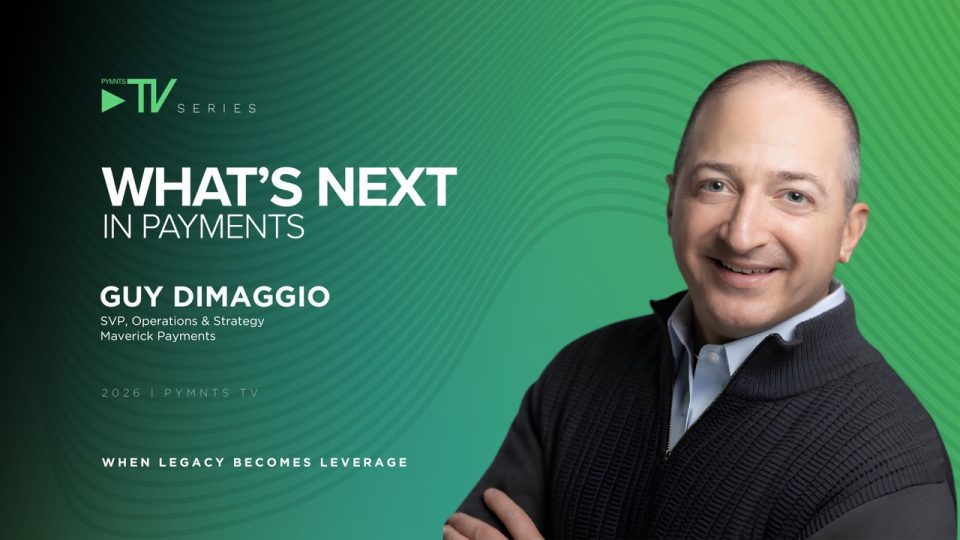
“It’s the core backbone of authorization, clearing and settlement,” Guy DiMaggio, SVP of operations and strategy at Maverick Payments, told PYMNTS. “So it’s very much created the very strong foundation that our industry is built on.”
This interview was part of the PYMNTS “What’s Next in Payments” series examining legacy technology and the ways financial services firms are reassessing infrastructure that has long defined the movement of money.
DiMaggio said the central challenge facing many incumbents is not recognizing that the market has changed. Rather, it is the practical challenge of adjusting systems, underwriting frameworks and operational procedures that were designed for a different merchant environment.
“It’s difficult to pivot once you have something that’s so longstanding and well established,” he said, noting that slower onboarding processes and rigid operational structures can create friction as merchant demands evolve.
That pressure has created an opening for newer firms that were built around speed and flexibility from the outset.
“They are capitalizing on speed,” DiMaggio said of newer entrants. “They are capitalizing on flexibility, whether it be flexibility in credit policies, flexibility in onboarding, flexibility in API connectivity and the various technologies.”
He noted eCommerce merchants, subscription models, digital services providers and higher-risk verticals frequently require customized underwriting standards, dynamic risk monitoring and more adaptable onboarding procedures.
DiMaggio said those demands extend well beyond transaction processing. Merchants increasingly expect rapid reporting capabilities, tailored integrations and faster responses to changing business conditions. They also expect providers to accommodate different risk profiles without forcing every business into identical operational categories.
Despite rapid automation across payments, merchants and agents still require direct access to knowledgeable personnel when disputes, underwriting issues or operational disruptions arise, he said. The human element, he told PYMNTS, is particularly important as newer payment flows create added complexity around underwriting, fraud mitigation and chargeback management.
Risk Pressures Are Changing Alongside Payment Demands
The expansion of digital commerce has altered the risk equation for processors and payment providers alike. Faster onboarding can accelerate merchant acquisition, but it can also increase exposure if underwriting standards fail to keep pace with evolving fraud patterns and operational risks.
“When you’re handling your own risk, you’re handling dynamic chargebacks, your own underwriting and support, we have the ability to take the good parts of the legacy infrastructure and yet be nimble,” he said.
We’d love to be your preferred source for news.
Please add us to your preferred sources list so our news, data and interviews show up in your feed. Thanks!
He added that payment providers increasingly need systems capable of adapting to higher-risk merchants, customized transaction flows and more varied customer expectations without sacrificing compliance or operational reliability.
That balancing act has become more difficult as merchants seek newer forms of payment acceptance, broader international reach and more direct integration into business software platforms. Real-time expectations now influence everything from settlement timing to reporting capabilities.
At Maverick, that approach includes managing multiple sponsor bank relationships, underwriting a wide range of merchant categories and building technology integrations designed to accommodate customized onboarding and reporting requirements.
“We sit as an FSP, we have our own BINS, we take liability, we have multiple sponsor banks,” DiMaggio said. “We take everywhere from low risk to moderate risk to high risk type of business.”
Partnerships Become Operational Necessities
DiMaggio said the growing complexity of payments has also made partnerships more important across the ecosystem. In his view, neither incumbents nor challengers can operate effectively in isolation.
“I truly don’t believe that in today’s market that one can be successful solo,” he said.
That dynamic extends beyond technology partnerships. It also includes operational coordination around compliance, risk management, onboarding standards and data safeguards.
While newer firms may move more quickly, DiMaggio said they can encounter difficulties when scaling operational controls or safeguarding sensitive information or managing complicated merchant portfolios. Legacy institutions, meanwhile, may possess stronger infrastructure and compliance frameworks but struggle to adapt rapidly to changing market demands.
As a result, firms positioned between those worlds may play a connective role.
“There’s much to be gleaned and leveraged from the legacy players,” DiMaggio said. “They make up the ‘pavement’ on which we all drive.”


 Add as Preferred Source