As stablecoins, real-time payment networks and artificial intelligence converge, financial infrastructure providers are confronting the fact that competitive questions are now becoming architectural ones.
But building a system in which software can initiate transactions across borders, currencies and banking networks, without compromising the controls that make those transactions trustworthy, is something easier said than done.
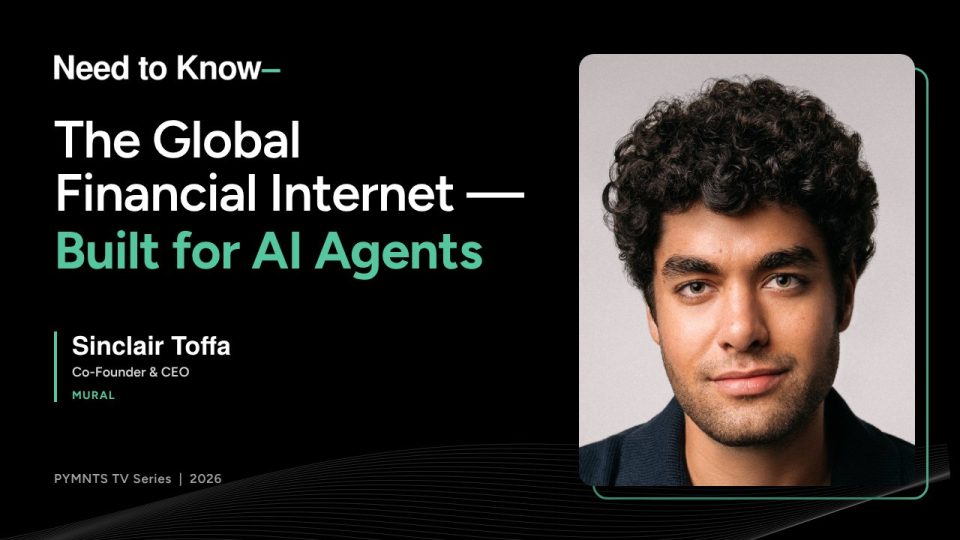
It is a paradox that Karen Webster, CEO of PYMNTS, put directly to Sinclair Toffa, co-founder and CEO at Mural, in a recent conversation.
“Embedding capabilities into software and creating interoperability between buyers and sellers, traders, on opposite ends of a transaction is something that the FinTech ecosystem and even legacy players have been tackling for decades,” Webster said. “So, what’s new?”
“Agents are the new interface,” Toffa said, comparing their emergence to the transition from desktop computing to mobile applications and predicting that AI agents could initiate 5% of cross-border payment transactions within the next year.
“We need to develop new systems that are agent native and agent oriented,” he said.
The Global Payments Problem Is No Longer Just About Moving Money
To scale across financial services responsibly, AI agents will need dedicated financial accounts, granular permissions and transaction-level audit trails rather than unrestricted access to existing banking relationships. That makes Toffa’s 5% forecast an aggressive one, particularly given the industry’s unresolved questions around authorization, liability and oversight.
A former Palantir engineer, Toffa said his firm is attempting to standardize the software objects that connect existing networks, allowing businesses to interact with fragmented financial systems through a common application programming interface by an architecture that incorporates compliance records, permissions and audit trails into the underlying financial software.
Toffa pointed to Starbucks as an example of a company that has effectively incorporated financial functionality into its customer experience. Embedded wallets, interest-bearing accounts, rewards and foreign exchange capabilities can help platforms deepen customer relationships while potentially capturing more economic value.
The next phase could extend that model beyond consumer platforms to businesses operating across multiple currencies and jurisdictions. The commercial thesis, Toffa added, is that financial fragmentation increasingly represents a software and governance problem, not simply a shortage of payment rails.
The approach also reflects the growing commercial reality that businesses themselves also want to retain the financial activity their platforms generate.
Turning Stablecoins Into a Distribution Strategy for Dollars
Banks, payment networks, stablecoin issuers and infrastructure providers are increasingly converging on the same opportunity, but from different positions in the financial stack. Mural’s bet is that connecting these systems through a standardized compliance and permissioning layer can create value without replacing the institutions underneath.
Toffa called this vision a “global financial internet.”
In Latin America, he said, businesses frequently encounter a mismatch between the currencies in which they operate and those in which they transact internationally.
A company earning dollars, converting them into local currency and subsequently converting them back to pay an overseas supplier can incur repeated foreign exchange costs. Stablecoin-enabled financial products offer a way to reduce some of that friction, although conversion, redemption and liquidity risks remain.
“A lot of businesses and individuals want to hold in dollars,” Toffa said. “A lot of them have difficulty opening up U.S. dollar bank accounts.”
Mural’s work with global payroll provider Deel illustrates how this demand can translate into a business model. By supporting stablecoin payouts to workers in Latin America, Mural connects enterprise payment activity with recipients seeking dollar-denominated funds and compatibility with local digital wallets.
The Next Payments Bottleneck Is Permission, Not Settlement
But the future of autonomous payments may depend, to an outsize degree, on who controls the risk. The question is no longer just whether money can move instantly. It is whether businesses can trust software to move it independently and establish who pays when the software gets it wrong.
As Webster emphasized, trust must be established and liability clarified before autonomous payments can scale.
For businesses, the ultimate value of a global financial internet can therefore be measured less by how quickly money moves than by how confidently companies can delegate the authority to move it.
Watch the full interview with Mural Co-Founder Sinclair Toffa and PYMNTS CEO Karen Webster to hear more about:
- Why the next payments breakthrough may be about permissions, not speed. Toffa explains how connecting fragmented banks, wallets and payment networks requires a common infrastructure layer that embeds compliance, authorization and auditability into every transaction.
- Why stablecoins are becoming a solution to the dollar access problem. Toffa and Webster discuss how businesses in Latin America are using digital dollars to reduce foreign exchange friction, access global financial services and move money without relying on traditional banking infrastructure alone.
- Whether AI agents could initiate 5% of cross-border payments within a year. Toffa predicts rapid growth in autonomous transactions, while Webster challenges whether businesses will surrender financial control before questions of trust, liability and agent-specific permissions are resolved.