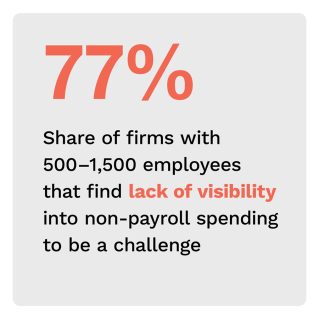
Providers of business-to-business (B2B) software-as-a-service (SaaS) solutions rely on their finance teams to track financial performance and provide key performance indicators (KPIs) to help fuel decision-making and company growth. 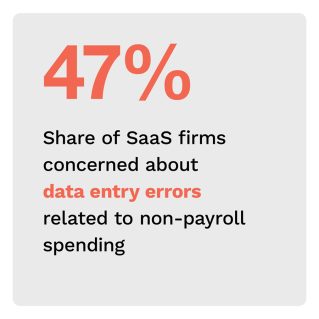 However, one major thorn in their side remains: a lack of full visibility and proactive control of non-payroll spending, including supplier invoices and employees’ expenses. In fact, more than 90% of firms surveyed do not have full visibility or control of non-payroll spending until it occurs.
We’d love to be your preferred source for news.
Please add us to your preferred sources list so our news, data and interviews show up in your feed. Thanks!
Designed to deploy, track and control the money companies expend to drive growth, non-payroll spend management often relies on inefficient processes. Facing considerable costs and frictions, SaaS businesses expressed interest in one system that would allow them to manage different types of non-payroll spend while enabling accounts payable (AP) teams to work more efficiently and provide faster, more accurate reports to management. Among firms that do not have such a system, 84% would be at least somewhat interested in using one, and 90% are at least somewhat willing to pay for it.
 “The Financial Performance Quandary: Leveraging Automation To Better Manage Non-Payroll Spending,” a PYMNTS and Airbase collaboration, examines how much time and effort AP teams devote to managing non-payroll spending, the impact of inefficient processes on business health, and how an automated system can streamline non-payroll spend management and improve financial performance.
More key findings from the study include:
• Lack of visibility and control of non-payroll spending costs SaaS firms roughly 4% of their total expenses. AP teams must manage wasted spend, including zombie, unauthorized, unwanted, duplicative or unnecessary spending, when processing all non-payroll spending — the expenses employees incur and payments based on supplier invoices. 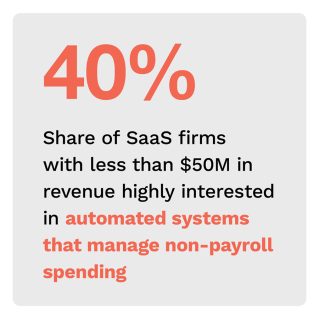 Having full visibility and control over non-payroll spending would help firms save approximately 11% of their total wasted spend, which totals between 4.1% to 4.4% of all expenses.
• Nearly half of firms face data entry errors when managing non-payroll spending, and an average of 10% of payments require adjustments due to errors when processing. These frictions most affected small firms in the last 12 months. Data shows that 47% of firms face data entry errors when managing non-payroll spending. This is the biggest challenge for 20% of executives surveyed. Due to errors when processing, an average of 10% of payments to suppliers require adjusting for SaaS firms. For 37% of firms, these payments represent more than 10% of total payments to suppliers in the last 12 months.
To learn more about how an automated system can help SaaS firms better manage non-payroll spending and give finance teams improved visibility and control of those payments, download the report.



 Add as Preferred Source