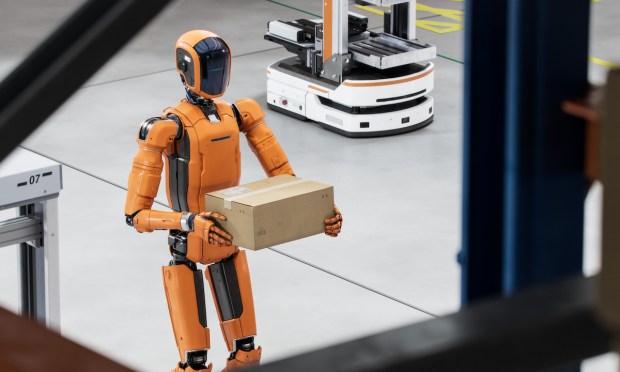
Humanoid robots have become one of the most visible symbols of artificial intelligence (AI) moving from software into the physical economy.
Built to walk, lift, grasp and interact in human environments, they are often positioned as a general-purpose answer to labor constraints and rising operating costs. But emerging evidence suggests their real-world productivity remains far below expectations.
Recent industry research cited by the Financial Times shows that humanoid robots are operating at less than half the efficiency of human workers in early deployments, based on metrics such as task completion speed, reliability and sustained output. While robots can perform individual actions competently, they struggle to match humans when tasks require fluid sequences, adaptation or uninterrupted execution in dynamic environments.
This productivity shortfall is beginning to reshape expectations. Companies experimenting with humanoid robots are increasingly treating them as long-term bets rather than short-term efficiency tools. Even well-funded pilots often require extensive human supervision, frequent resets and environmental adjustments that dilute the promised gains. Instead of accelerating output, many deployments introduce new layers of complexity that offset automation benefits.
Why Physical Intelligence Remains the Limiting Factor
The primary bottleneck is not cognitive intelligence but physical execution. While advances in large language models have improved robots’ ability to interpret instructions and plan actions, translating those plans into reliable movement remains difficult. Real-world environments are noisy, irregular and full of edge cases that machines handle poorly.
Vision systems are sensitive to lighting changes, reflections and partial occlusion. Grasping systems fail when objects vary slightly in shape or weight. Locomotion consumes significant energy and compute, limiting how long robots can operate at productive levels without recharging or recalibration. Each failure introduces downtime, eroding throughput and consistency.
We’d love to be your preferred source for news.
Please add us to your preferred sources list so our news, data and interviews show up in your feed. Thanks!
Academic research reinforces this pattern. A study from the Massachusetts Institute of Technology examining AI’s impact on productivity found that AI systems tend to deliver weaker gains in settings that require contextual judgment, adaptation and real-time physical interaction. Productivity improvements were strongest where tasks were structured, predictable and tightly scoped, conditions that humanoid robots rarely encounter outside lab environments.
Futurism pointed to mounting evidence that AI systems, including embodied AI, often fail to boost productivity at scale because performance degrades outside ideal conditions. Small inefficiencies compound over time, turning marginal slowdowns into material operational drag.
The challenge is compounded by training constraints. Teaching robots to handle edge cases requires large volumes of real-world data, which is expensive and slow to collect. Simulation helps but does not fully capture physical unpredictability. As a result, improvements arrive incrementally rather than through rapid step changes, limiting short-term productivity impact.
Where Robots Are Delivering Measurable Productivity Gains
Despite these limitations, robots are delivering tangible productivity improvements in narrowly defined use cases. The strongest gains appear in repetitive, high-volume tasks where environments can be optimized for machines rather than humans.
Warehousing and logistics stand out as early successes. Robots used for picking, sorting and transporting standardized packages have improved throughput and reduced error rates by operating continuously and consistently. These systems benefit from structured layouts, known object dimensions and fixed workflows that minimize variability. In such settings, productivity gains come from endurance and precision rather than adaptability.
But Gartner has warned that humanoid robots are unlikely to deliver broad productivity gains across global supply chains in the near term, arguing that most value today comes from task-specific automation layered into existing operations rather than wholesale replacement of human workflows, according to Supply Chain Digital.
The Wall Street Journal has similarly argued that productivity growth depends less on humanoid form factors and more on how well automation aligns with economic reality. Technologies that complement human labor in constrained domains tend to scale faster than those attempting full general-purpose substitution.


 Add as Preferred Source