Americans facing higher bills are taking three different approaches to their paychecks, and the largest group is still holding spending steady or increasing it. That finding helps businesses avoid treating every stretched household as a consumer preparing to stop buying.
PYMNTS Intelligence’s “The Fragmented Paycheck: Why Rising Spending No Longer Means Stronger Demand,” part of The American Paycheck 2026 Annual Edition, examines how households earn, spend and manage financial pressure. It draws on four research programs covering financial lifestyles, generational behavior, credit use and consumer expectations.
We’d love to be your preferred source for news.
Please add us to your preferred sources list so our news, data and interviews show up in your feed. Thanks!
The report finds that rising spending can reflect higher prices while households save less. Yet consumers’ responses vary. Its three behavioral groups—reactive, proactive and balanced—describe how people manage money rather than how old they are or how much they earn. Think of a household budget as a dashboard: income shows the speed, while savings and payment obligations reveal how much fuel remains.
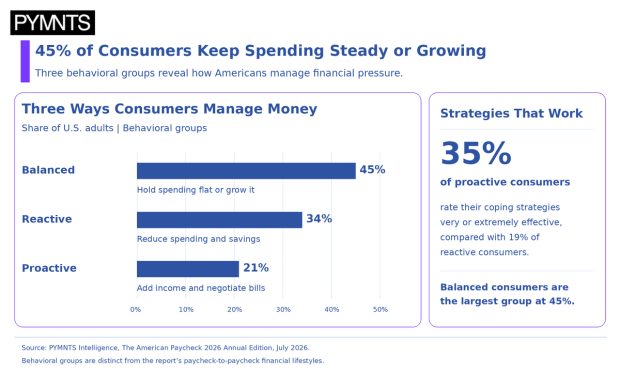
- Balanced consumers account for 45% of adults. They held spending flat or increased it and saved more than either of the other groups. Their position provides a constructive signal for merchants: the largest segment continues to support purchases while maintaining stronger saving behavior. Still, they aren’t immune to pressure. The report identifies changes in this group’s saving behavior as an early indicator of whether more households may begin cutting back.
- Reactive consumers represent 34% of adults. They reduced both spending and savings, relying heavily on cutting everyday expenses and avoiding purchases. Only 19% rate their coping strategies as very or extremely effective. Their experience shows why lower spending alone doesn’t necessarily improve financial security. Among boomers, 69% of reactive consumers face daily living pressure, compared with 38% of balanced consumers, a 31 percentage point difference within the same generation.
- Proactive consumers make up 21% of adults. They supplement income, negotiate bills and use installment payments to manage expenses, even while facing the heaviest financial challenges of the three groups. Some 35% describe their coping strategies as very or extremely effective, compared with 19% of reactive consumers. Buy now, pay later use as a coping tool reaches 48% among proactive consumers, versus 8% among reactive consumers.
The broader findings suggest room for banks and merchants to help households plan more effectively. Across consumers, 66% cut everyday spending and 51% avoid large purchases, while just 21% negotiate bills. Income also arrives from multiple sources: 37.6% of workers did side work during the previous six months. Clear payment schedules, predictable prices and tools that help consumers track irregular earnings could address those practical needs.
Consumers haven’t all responded to financial strain the same way, and businesses can serve them more effectively by recognizing the differences.
At PYMNTS Intelligence, we work with businesses to uncover insights that fuel intelligent, data-driven discussions on changing customer expectations, a more connected economy and the strategic shifts necessary to achieve outcomes. With rigorous research methodologies and unwavering commitment to objective quality, we offer trusted data to grow your business. As our partner, you’ll have access to our diverse team of PhDs, researchers, data analysts, number crunchers, subject matter veterans and editorial experts.


 Add as Preferred Source