Businesses looking to automate supplier payments are giving technology teams a bigger say in purchasing decisions, and the reason starts with a practical priority: making new software work with what they already have.
The July 2026 “Business Payments Tracker®” from PYMNTS Intelligence and WEX, “Who Decides Now: How Developers and Tech Teams Are Reshaping the Future of AP Payments,” examines that shift in accounts payable, or AP, the function that manages supplier bills and payments. Drawing on several research sources, the report finds that connecting systems and getting software running increasingly influence buying decisions alongside financial benefits. Developers and IT specialists can help finance leaders assess those requirements before a purchase. Think of payment software as a new appliance: Its features won’t deliver much value unless it connects properly to the building’s wiring.
We’d love to be your preferred source for news.
Please add us to your preferred sources list so our news, data and interviews show up in your feed. Thanks!
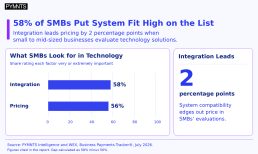
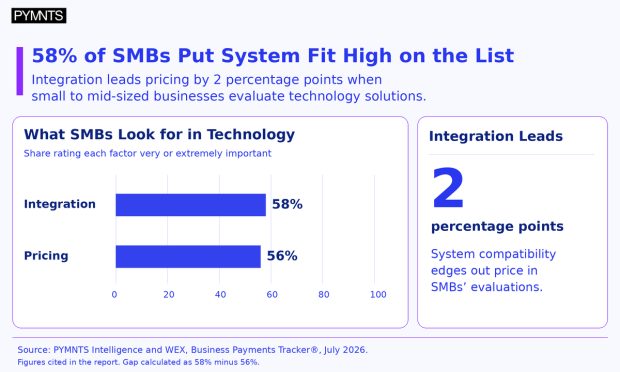
- System compatibility gets priority. Research cited in the report finds that 58% of small to mid-sized businesses consider integration very or extremely important when evaluating technology, compared with 56% for pricing. That’s a 2-percentage-point lead. Separately, 62% of businesses identify ease of connecting with their central business management system as the most important factor in choosing AP automation. For providers, those findings suggest that demonstrating how a product fits a customer’s existing operations deserves attention early in the sales process.
- Automation still leaves substantial manual work. Although 89% of organizations report using at least some AP automation, half still process more than 5,000 invoices monthly through workflows that aren’t fully automated. Another finding shows that 67% spend at least five days each month processing invoices. Those figures highlight an opportunity to improve the connections between individual tasks, helping teams spend less time entering information or resolving gaps between systems.
- A smoother launch carries financial weight. Easy integration, easy implementation and proven return on investment each rank among the leading AP automation adoption factors for 40% of organizations. Workflow efficiencies follow at 37%. The findings give finance and technology teams common ground: evaluating how a product will work in practice can help protect the value of the investment. Clear documentation and realistic testing environments can help developers identify problems before payments begin running through a new system.
The potential payoff extends beyond faster invoice handling. Research cited in the report finds that 92% of organizations believe automating invoice management and supplier payments would let finance teams focus on more strategic initiatives. Payment capabilities built directly into existing software can also improve visibility and reduce the work of matching payments to records. The report recommends involving technical specialists early and choosing systems that can accommodate future growth.
At PYMNTS Intelligence, we work with businesses to uncover insights that fuel intelligent, data-driven discussions on changing customer expectations, a more connected economy and the strategic shifts necessary to achieve outcomes. With rigorous research methodologies and unwavering commitment to objective quality, we offer trusted data to grow your business. As our partner, you’ll have access to our diverse team of PhDs, researchers, data analysts, number crunchers, subject matter veterans and editorial experts.
See More In:
accounts payable, automation, data brief, data point, featured insights, Featured News, News, Payments Intelligence, PYMNTS Intelligence, PYMNTS News, WEX


 Add as Preferred Source