The next stage of Pay Later may look less like a single checkout button and more like a credit menu built for different kinds of buyers.
That is one of the clearest signals from “Pay Later Revolution: Redefining the Credit Economy,” a PYMNTS Intelligence Framework Series report on how credit cards, BNPL providers, banks, merchants and payment networks are reshaping installment lending.
We’d love to be your preferred source for news.
Please add us to your preferred sources list so our news, data and interviews show up in your feed. Thanks!
The report finds that Pay Later has moved well beyond its early “Pay in 4” identity. Short-term buy now, pay later (BNPL) providers are stretching into longer-term loans, while lenders focused on larger purchases are moving into smaller, everyday transactions. The result is a market that increasingly resembles a restaurant menu with small plates, family meals and premium specials, all designed for different appetites and budgets.
The optimistic read is simple: A more flexible Pay Later market could give consumers more control over how they manage cash flow, while giving banks, FinTechs and merchants more ways to serve them responsibly. That opportunity depends on matching the product to the buyer, not treating all installment users as the same.
Key data points show how much the market has broadened:
- 38% of American consumers used BNPL toward the end of 2024, up from 24% the prior year. The report says BNPL usage had reached roughly the same level as general-purpose credit cards, whose usage did not rise year over year. That suggests consumers are not just trying BNPL. They are adding it to their regular payment toolkit.
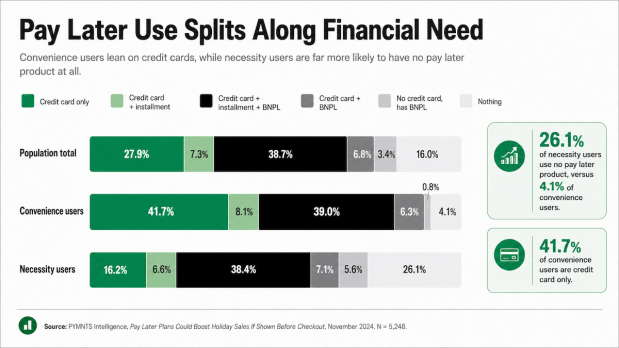
- 51.2% of adult BNPL users do so out of necessity, compared with 46.1% who use it for convenience. Necessity users often have less access to traditional credit and may use BNPL for groceries or other everyday purchases. Convenience users tend to have stronger credit profiles and use installments to preserve liquidity, earn card rewards or manage larger purchases.
- 61.4% of convenience BNPL users earn at least $100,000 a year. That finding helps explain why Pay Later is expanding in both directions. It supports consumers who need short-term help, but it also appeals to higher-income shoppers who want predictability and optionality.
The report also shows the risks that come with growth. More than 6 in 10 BNPL users hold multiple active BNPL loans at the same time, and nearly 30% of BNPL loans were past due in mid-to-late January 2025. That could push providers to improve underwriting, repayment reminders and transparency as the market matures.
Other findings point to a more connected future. Banks are adding installment features to credit cards. Merchants increasingly prefer bank-backed options because they can avoid extra checkout integrations. BNPL providers are building shopping apps, loyalty features and longer-term financing. Regulators, meanwhile, are watching loan stacking, disclosures and consumer protection. The Pay Later ecosystem is still changing quickly, but its strongest path forward may be practical: more choices, clearer terms and products that fit how consumers actually live.
At PYMNTS Intelligence, we work with businesses to uncover insights that fuel intelligent, data-driven discussions on changing customer expectations, a more connected economy and the strategic shifts necessary to achieve outcomes. With rigorous research methodologies and unwavering commitment to objective quality, we offer trusted data to grow your business. As our partner, you’ll have access to our diverse team of PhDs, researchers, data analysts, number crunchers, subject matter veterans and editorial experts.


 Add as Preferred Source