Younger generations are no longer a future growth segment for credit unions. They are an active, demanding customer base whose expectations around payments are shaping product decisions today.
The latest PYMNTS Intelligence findings with Velera, detailed in “Pay Later’s Next Chapter: Why Credit Unions Are Rethinking Installment Payments,” show that installment plans have become embedded in everyday commerce.
The report highlights that installment payment value rose 22% year over year, with transaction volume also increasing, a signal that usage is broadening rather than concentrating in a few categories. Consumers are using installments for travel, services and recurring expenses, indicating that flexible payment timing has become part of basic financial management.
Gen Z Treats Installment Payments as a Default Option
For Gen Z, installment payments are not viewed as an alternative to credit. They are increasingly treated as a standard way to pay. The report finds that 70% of Gen Z consumers would use buy now, pay later (BNPL) options if offered by their primary financial institution, a higher level of interest than older cohorts.
This preference reflects both behavioral and economic factors. Younger consumers tend to favor tools that provide immediate clarity on repayment terms and avoid revolving balances. Installments offer fixed schedules and defined costs, which align with a desire for predictability and control. In addition, many Gen Z users encounter these options first at the point of sale, where merchants and digital wallets present them prominently.
We’d love to be your preferred source for news.
Please add us to your preferred sources list so our news, data and interviews show up in your feed. Thanks!
The normalization of installments at checkout has shaped expectations beyond retail. Younger members now assume that flexible payment options should be available wherever they manage money, including within their primary banking relationships. When those options are absent, they are willing to look elsewhere.
A Retention Tool
For credit unions, the implications extend beyond product design. Allowing installment activity to occur outside their ecosystems means forfeiting both transaction volume and insight into member behavior. Over time, that can weaken engagement, particularly with younger members who are still forming long-term financial habits.
Offering installment options directly within digital banking platforms presents a way to address both issues. By integrating these tools into existing account views, credit unions can provide a consolidated picture of spending and repayment. This reduces the need for members to manage multiple apps and payment schedules, addressing one of the key pain points identified in the report.
There is also a strategic dimension. When installment payments are handled internally, credit unions retain visibility into how members finance purchases, manage cash flow and respond to different repayment structures. That information can support more tailored product offerings and more effective financial guidance.
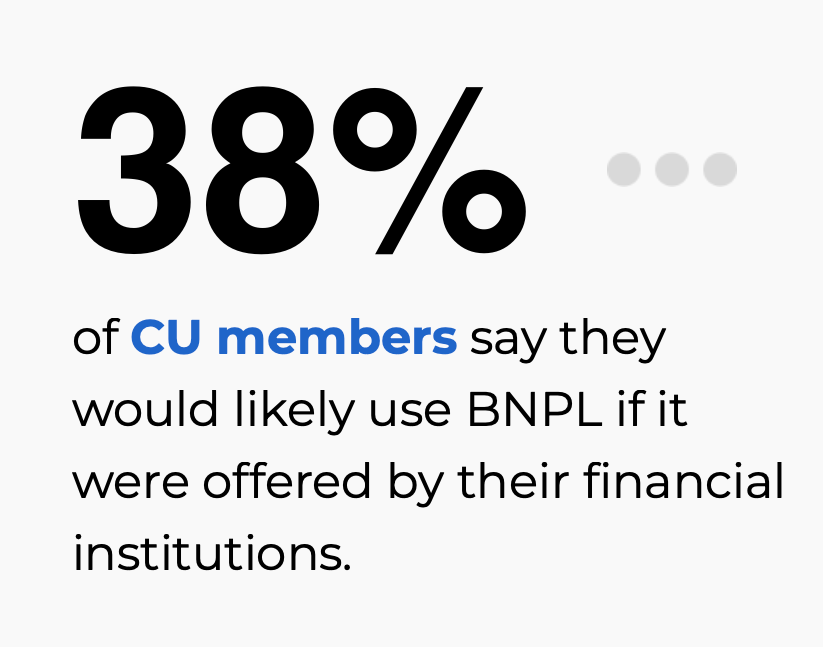
While 38% of credit union members say they would likely use BNPL if offered by their institution, many credit unions have yet to deploy these capabilities at scale. In the absence of in-house options, third-party providers continue to fill the gap, embedding themselves within merchant checkouts and digital wallets.
Closing that gap requires more than simply launching a product. Credit unions must also ensure that members are aware of these options and understand how they fit within their broader financial lives. Education, clear communication and integration into familiar digital interfaces all play a role in encouraging adoption.
At PYMNTS Intelligence, we work with businesses to uncover insights that fuel intelligent, data-driven discussions on changing customer expectations, a more connected economy and the strategic shifts necessary to achieve outcomes. With rigorous research methodologies and unwavering commitment to objective quality, we offer trusted data to grow your business. As our partner, you’ll have access to our diverse team of PhDs, researchers, data analysts, number crunchers, subject matter veterans and editorial experts.



 Add as Preferred Source