Digital wallets are no longer simply changing how consumers present a payment at checkout. They’re also beginning to change where the money comes from.
That shift stands out in “Apple Pay @11: Usage Is Up, but Competitors Are Gaining Ground,” a PYMNTS Intelligence report based on a survey of 3,339 U.S. consumers.
We’d love to be your preferred source for news.
Please add us to your preferred sources list so our news, data and interviews show up in your feed. Thanks!
The findings show that mobile wallet use is rising in stores and online, while Apple Pay’s rivals are also attracting more users. More than 3 in 10 consumers used a mobile wallet in a store during the previous week, more than double the share reported in 2024. The report also finds that consumers increasingly fund wallet purchases with balances held directly inside digital platforms.
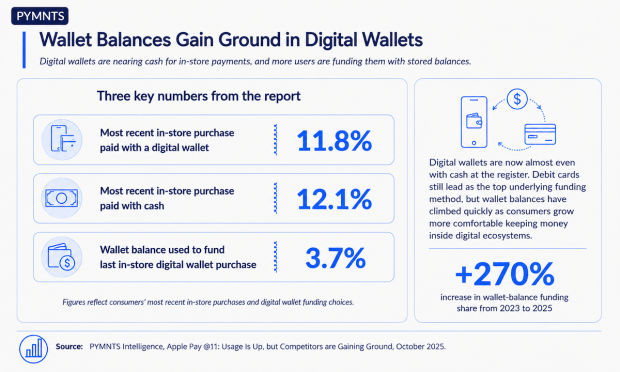
Three figures illustrate how rapidly the payment mix is changing:
- 11.8% of consumers used a digital wallet for their most recent in-store purchase in 2025. That share stood at just 0.9% in 2022.
- 12.1% used cash for their most recent store purchase, down from 17.6% three years earlier. Digital wallets now trail cash by only 0.3 percentage points.
- 3.7% paid for their latest in-store wallet purchase using a stored wallet balance, up from 1% in 2023. That represents a 270% increase.
The movement toward stored balances gives digital wallets a broader role in the payment process. A wallet that once acted mainly as a digital sleeve for a physical card can increasingly function like a small account of its own. The change could help providers create a smoother checkout experience while giving consumers another way to organize funds and make purchases.
Traditional cards remain central to that system. Debit cards were the largest underlying funding source for consumers’ latest in-store wallet transactions, at 4.1%, followed closely by wallet balances, at 3.7%. Credit cards accounted for 2.5%, while bank transfers and other methods remained below 1%.
The broader report shows that wallets are expanding alongside established payment methods rather than replacing them outright. Debit represented 46.3% of consumers’ latest in-store transactions in 2025 and credit accounted for 31.7%. Cash or stored balances represented 15.9%. That mix suggests digital wallets can gain ground while keeping banks and card issuers firmly connected to the purchase.


 Add as Preferred Source