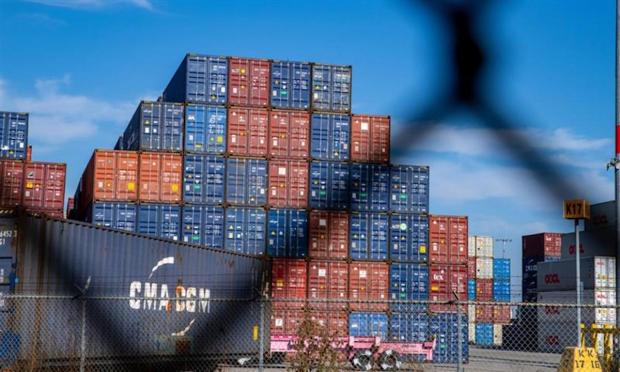
American manufacturers are reportedly scaling back parts and raw material orders amid tariff-related uncertainty.
Buying activity by manufacturers in the U.S. reached its lowest level since May last month, The Wall Street Journal (WSJ) reported Wednesday (Dec. 10), citing a poll of 27,000 businesses by software consulting firm GEP and S&P Market Intelligence.
As the report notes, U.S. manufacturers and retailers are awaiting a Supreme Court ruling on the constitutionality of the White House’s “reciprocal” tariffs.
At a hearing last month, justices showed skepticism about the legality of the tariffs. The Trump administration has asked the court to issue a decision as quickly as possible, with a ruling expected in the coming months.
“A lot of folks are just sort of hedging a little bit that these tariffs are going to get rolled back,” Mike DuVall, global head of supply chain strategy at GEP, told the WSJ.
The report says the survey’s findings contrasts with companies elsewhere in the world, where supply chain activity, while weak, is still stronger than in the U.S. GEP says manufacturing demand in Europe is flat and activity in Asia is slowing on waning demand from China.
The survey follows one from earlier this month showing that the Institute for Supply Management’s (ISM) manufacturing index had been in decline for nine consecutive months.
The survey data indicated the nation’s manufacturing base remains hindered by ongoing trade policy uncertainty and rising production costs. Customer demand has been tepid, leading to orders contracting in November at the quickest pace seen since July, while backlogs shrank by the most in seven months.
Susan Spence, chair of the ISM Manufacturing Business Survey Committee, told Bloomberg News that uncertainty regarding tariffs is fueling the pullback as customers hold off on orders as they wait for greater clarity on the cost of goods.
“We do not see anything on the horizon that’s going to turn the ship,” until that certainty arrives, Spence added.
Meanwhile, recent research shows that companies have stopped waiting on lawmakers to offer clarity on tariffs.
The latest edition of The Certainty Project from PYMNTS Intelligence, titled “Profit Slips, Policy Shifts: Product Leaders Navigate the Crossfire,” found that businesses no longer are no longer thinking of tariffs as temporary turbulence.
“Instead, they are adjusting portfolios, forecasting models and supply strategies around the assumption that trade levies will define the landscape for years,” PYMNTS wrote last month.