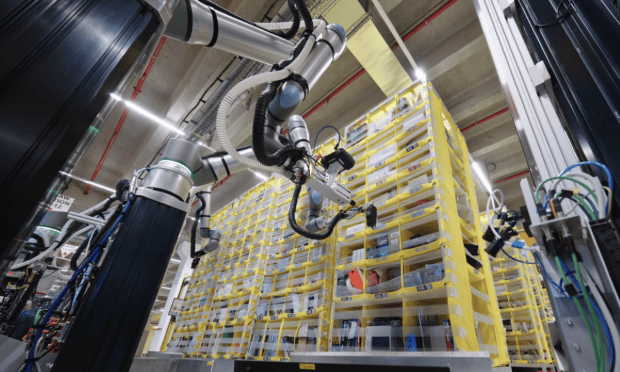
The robot handles roughly 1,500 single-item orders per day at the company’s largest fulfillment center in Arbon and works through the night. The deployment paid for itself in about nine months, a return MS Direct attributed in part to Switzerland’s high labor costs, MassRobotics reported.
That warehouse runs on a Kardex AutoStore system, a grid-based setup where robots retrieve bins and deliver them to picking stations. For years, the company couldn’t automate most of that process: Its inventory was too varied for any available robot.
SKU Complexity Keeps Most Warehouse Picking Manual
That challenge extends across the industry. Picking and packing represent the bottleneck preventing lights-out warehouse operations, with SKU chaos and packaging variance among the primary barriers to full automation.
Conventional systems require product images, grip instructions or manual tests before handling an unfamiliar item. That work repeats whenever a retailer adds merchandise or changes packaging. In eCommerce fulfillment, that happens constantly.
The Arbon warehouse holds more than 60,000 SKUs. That range broke the first pick robot MS Direct tested. Many products were unknown to the system. Picking stayed manual at eight of the nine AutoStore ports.
Zero-Shot AI Removes Item-Level Robot Training
We’d love to be your preferred source for news.
Please add us to your preferred sources list so our news, data and interviews show up in your feed. Thanks!
Sereact’s system analyzes each object in real time, identifying shape, material and color. Then it selects a grip without product-specific training, Packaging Journal reported. The software handles new items without image sets or manual teaching. It also adjusts grip and movement in real time if an item shifts during a pick. One in roughly 53,000 picks requires remote human intervention, Sereact CEO Ralf Gulde told MassRobotics.
The model is trained on production data rather than simulations. Every successful pick, every failure and every recovery is captured with synchronized observations, robot state, gripper force feedback and outcome, then used to continuously update the model. More than 200 Sereact systems are live across Europe, Those systems have completed over 1 billion real production picks for customers including BMW, Daimler Truck, PepsiCo and Austrian Post, MassRobotics reported.
Sereact raised $110 million in a Series B led by Headline in April to scale its next-generation Cortex model and open its first U.S. office in Boston, Bloomberg reported.
The problem isn’t limited to smaller operators. Amazon’s Vulcan robot, deployed in Spokane and Hamburg, uses force feedback sensors because most commercial robots cannot reliably detect or adapt to unexpected contact with an item. Amazon is investing €10 billion in its European fulfillment network, with Vulcan and other AI-powered warehouse systems central to that expansion, Reuters reported.
Amazon’s fulfillment network spans more than 200 facilities in Europe alone. Most third-party logistics providers run a fraction of that volume across dozens of clients, each with a different and changing product catalog.
Overnight Robotics Improve AutoStore Capacity and Payback
The AutoStore system had run predominantly during the day, leaving the site largely idle at night. The Sereact robot now fills that gap, handling picking throughout the night and raising output from infrastructure MS Direct already owned without adding a night-shift crew. Employees continue to handle orders that require judgment or fall outside the robot’s range.
Other AutoStore operators have built around similar logic. Electrical distributor Sonepar runs its systems around the clock, with its Zurich warehouse processing up to 1,200 order lines per hour and supporting same-day delivery, AutoStore said.
For all PYMNTS AI coverage, subscribe to the daily AI Newsletter.


 Add as Preferred Source