For payments executives, artificial intelligence (AI) is quickly becoming less interesting as a productivity tool than as a competitive weapon.
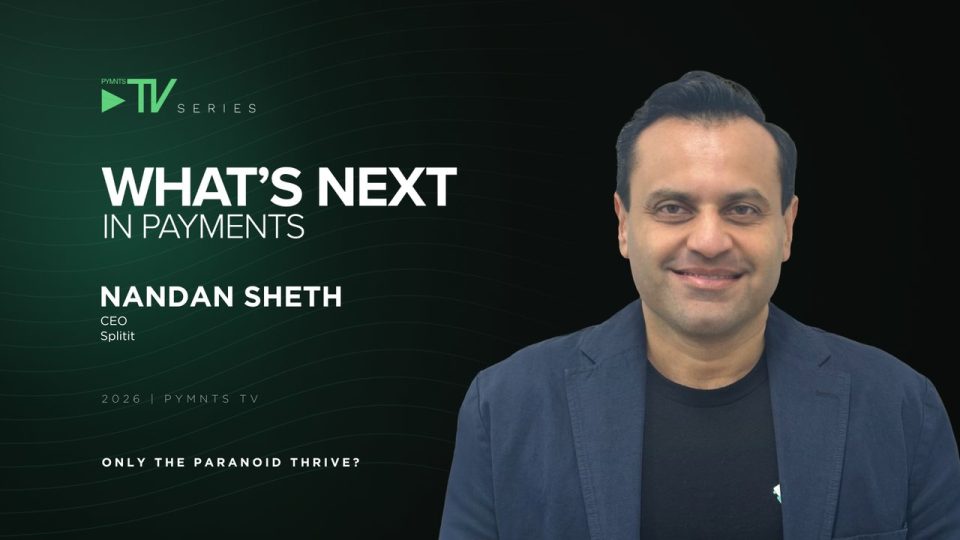
In conversation with PYMNTS for the August edition of the What’s Next in Payments series, “Only the Paranoid Thrive?” Nandan Sheth, CEO of Splitit, drew a sharp distinction between the two. Using AI to make employees faster, automate workflows or lower operating costs is becoming a baseline capability. The more consequential question is what happens when a competitor uses the technology to redesign the economics of a market altogether.
“AI improving productivity, to me, that’s table stakes,” Sheth said. “The real threat is someone using AI to remove entire layers of friction, cost and intermediaries within my segment.”
That distinction captures a broader strategic challenge confronting payments companies as AI begins moving from software deployed inside businesses to technology capable of reshaping how consumers discover, finance and pay for purchases. The competitive advantage, as a result, may belong not to the company with the most AI tools, but to the one willing to reconsider which parts of today’s payments architecture need to exist at all.
From Competitive Paranoia to Competitive Signals
Sheth rejected the familiar Silicon Valley maxim that CEOs should remain perpetually paranoid about competitors.
“Paranoia does not help me,” he said. “What does work for me is taking quick action on recognizable signals.”
Executives today have no shortage of signals. AI models are improving. Regulation is evolving. New payment methods are proliferating. Banks, FinTechs, networks and technology platforms increasingly overlap. The management problem is deciding which developments require action.
“If you don’t take action on that, it just becomes noise and it weighs you down,” Sheth said.
His approach combines conversations with competitors, investors and customers with signals extracted from Splitit’s own data. Sheth regularly speaks with private equity and venture capital investors tracking the sector and meets directly with customers. Even competitors can become useful sources of intelligence. And that human intelligence is increasingly complemented by machine analysis.
“There are so many signals in the data that AI or machine learning can help you garner,” he said.
The result is less a forecasting system than a feedback loop: identify changes, determine whether they matter and move before certainty arrives.
The Bigger AI Question Is What Gets Eliminated
That process becomes particularly important as companies assess artificial intelligence. For Sheth, the wrong strategic question is simply how much productivity AI can unlock. Nearly every sophisticated company will pursue those efficiencies. The harder exercise is imagining a competitor without the institutional baggage of today’s business.
“The question I ask is, what would someone build today if they weren’t constrained by our existing architecture, organization and assumptions?” Sheth said.
We’d love to be your preferred source for news.
Please add us to your preferred sources list so our news, data and interviews show up in your feed. Thanks!
That question changes the competitive frame. Payments companies have historically competed over acceptance, authorization rates, financing options, fraud, fees and user experience. AI creates the possibility that some of those competitive boundaries could be reorganized. Instead of improving an existing payment journey, a new entrant might eliminate steps within it.
For incumbent executives, that creates an uncomfortable requirement: They must simultaneously optimize today’s business and imagine a version of commerce in which portions of that business disappear.
Sheth uses a deliberately simple weekly system to manage that tension. Each Sunday evening, he identifies six priorities for the coming week. Roughly four are tactical and two strategic.
The simplicity is the point. Long-term disruption still has to compete for executive attention with contracts, customers and operational decisions that cannot wait.
Payments Disappear Into Commerce
One of the structural shifts Sheth is watching most closely is the disappearance of payments as a conscious consumer decision.
“Payments are being absorbed by commerce,” he said. “They’re becoming invisible within commerce.”
Generative AI could accelerate that transition because AI agents and personalized digital identities can potentially understand not only what consumers want to buy, but how they prefer to fund different categories of purchases. A consumer buying $15,000 in airline tickets, for example, might automatically use installments. A hotel transaction might be routed to the card offering the strongest rewards. Everyday purchases might default to debit.
Instead of consumers selecting among payment instruments at checkout, software could continuously orchestrate the cards, bank accounts and credit products available to them.
“I think over time, the payment method is going to become a lot less relevant,” Sheth said.
That would represent more than another checkout innovation. It would shift competitive power toward whoever controls the intelligence determining which payment method surfaces, when it appears and why. The implication for payment providers is that being available at checkout may no longer be sufficient. They may need to become attractive to the algorithms making the choice.
Watch the full PYMNTS TV episode with Splitit’s Nandan Sheth to hear more about:
- Why AI’s biggest threat to payments is not productivity — it’s disruption. Using AI to automate workflows and reduce costs is becoming table stakes. The greater competitive risk is a new entrant using AI to eliminate entire layers of friction, cost and intermediaries.
- Why payments executives need to act on signals before they become obvious. Sheth advocates replacing “paranoia” with a disciplined feedback loop: monitor customers, competitors, investors and company data, identify meaningful signals and act before certainty arrives.
- Why payments could become invisible inside commerce. AI agents may determine how consumers pay based on purchase size, rewards, financing preferences and other factors, shifting competitive power toward providers that can win the algorithms’ decisions rather than simply appear at checkout.


 Add as Preferred Source