Banks are rebuilding payments systems for transactions that may soon be initiated by software rather than people. That prospect changes what issuers need from the technology beneath a payment.
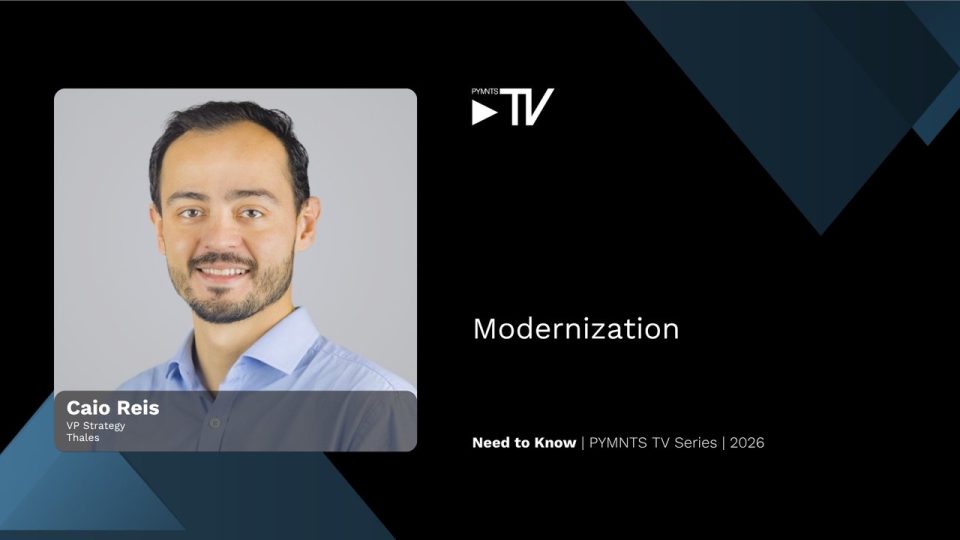
Caio Reis, vice president of strategy at Thales, told PYMNTS in an interview that artificial intelligence purchasing sits at the center of several developments that are often discussed separately, including authentication, payment credentials, tokenization and passwordless commerce.
Consumers already use generative AI to research products and compare prices, Reis said. The consequential step comes when AI moves from advising a shopper to completing a purchase autonomously.
“What is missing now is to be able to pay for yourself autonomously,” Reis said. “So, what does that mean? Tomorrow, the issuers will have to be ready to accept those payments. Those payments need to be authenticated.”
Payment passkeys, passwordless authentication and tokenization will become part of the infrastructure required to support that model, Reis said.
For issuers, modernization must move beyond a predetermined schedule toward the creation of the payments architecture that can accommodate capabilities whose commercial importance may develop quickly.
Reis said he sees an 18- to 24-month window in which banks need to prepare for what he called “identity commerce,” including the partners and technology needed to support it.
We’d love to be your preferred source for news.
Please add us to your preferred sources list so our news, data and interviews show up in your feed. Thanks!
Modernization: Competition, Not Cost Reduction
Competition has become another consideration as consumers use FinTechs and neobanks for more of their primary banking relationships. Reis said he is wary of “lift and shift” projects that transfer existing applications to the cloud without changing their underlying architecture. Such migrations may lower hosting expenses, but they leave much of the original technical and functional debt intact.
Modernization includes shorter software release cycles, lower operating costs, simpler technologies and an architecture capable of putting new services into customers’ hands without waiting for lengthy development schedules. Reis contrasted release cycles measured in weeks with legacy environments where software may be released only twice a year.
Changing that architecture, however, creates its own hazards. Reis identified integration complexity as one of the major risks, particularly when banks attempt to connect new technology to a dense collection of existing systems.
Banks should also manage migration risk, Reis said. A complete replacement may be necessary in some circumstances, while other institutions can migrate individual portfolios over several years. Another approach separates the customer-facing experience from the back end, allowing banks to modernize specific use cases while older and newer infrastructure coexist.
The front end can therefore change before every component underneath it has been replaced. Back-end functions can then migrate individually, reducing the operational exposure associated with a single large conversion.
AI purchasing, tokenization and passwordless authentication will add new requirements to payment systems. Banks that carry every legacy product variation, integration and decision process into the new environment may preserve many of the constraints they intended to remove.
Watch the full PYMNTS interview with Thales’ Caio Reis to hear more about:
- How banks can choose among big-bang, portfolio and use case migration strategies.
- Where multi-region projects encounter local product complexity.
- Why internal decision-making can become an overlooked source of delay in major technology programs.
For all PYMNTS AI coverage, subscribe to the daily AI Newsletter.


 Add as Preferred Source