For insurers, payments have long served as the moments when policyholders notice the mechanics of the relationship. A premium must be collected. A refund must arrive. Those transactions often define the customer’s impression of the carrier.
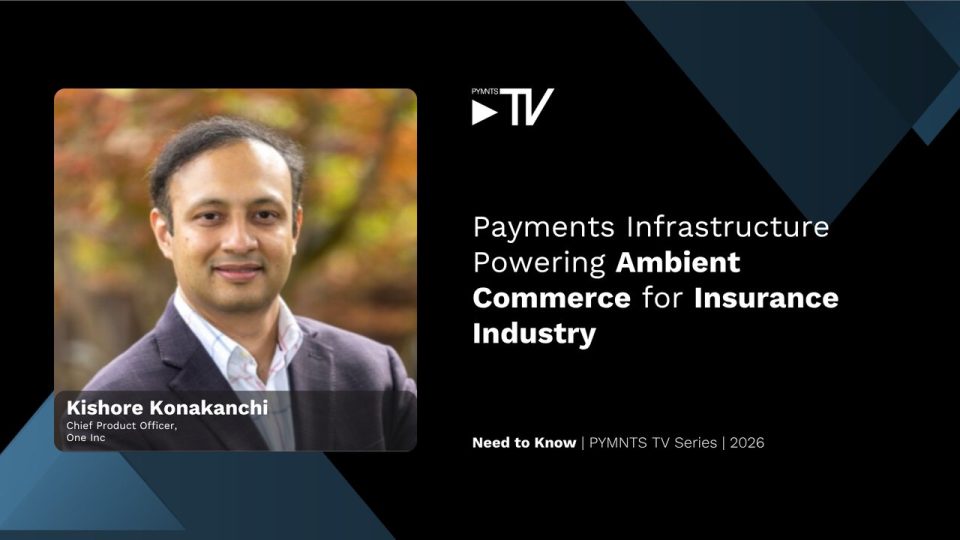
Kishore Konakanchi, chief product officer at One Inc, contended that the industry’s next objective is not simply digitizing those exchanges. It is removing payment from the customer’s field of vision while making the underlying infrastructure more intelligent.
Rather than describing ambient commerce as invisible payments alone, Konakanchi framed it as the ability to let policyholders accomplish what they intended without forcing them to think about how money moves.
“The future isn’t simply invisible payments,” Konakanchi told PYMNTS. “It’s about intelligent payments … Making payments fade into the background and intelligence behind it becomes the most valuable asset that the insurers will have going forward.”
Every payment serves as an opportunity to learn how policyholders prefer to interact, when payment behavior changes and where friction begins to emerge before it develops into a service problem.
Trust Before Intelligence
Konakanchi described the architecture supporting ambient commerce through what he called a “two-layer cake.”
The first layer is trust. Successful premium payments or claim settlements reinforces confidence that the insurer will perform as expected. Every failed payment has the opposite effect because customers immediately notice what had previously remained invisible.
We’d love to be your preferred source for news.
Please add us to your preferred sources list so our news, data and interviews show up in your feed. Thanks!
The second layer is intelligence that is on top of the trust layer, Konakanchi said.
That foundation requires more than processing transactions successfully. Konakanchi pointed to tokenization, payment card industry (PCI) compliance and secure outbound payments that avoid exposing bank account and routing information as prerequisites before insurers can begin extracting meaningful operational insight. Only after those controls are established does intelligence become useful.
That intelligence extends well beyond fraud screening. Konakanchi said insurers should continuously evaluate whether payment behavior appears normal, whether account information has changed unexpectedly, whether fraud indicators have emerged and which payment rail offers the best customer experience for a particular transaction. Those observations can also reveal retention risks before customers explicitly express dissatisfaction.
The same philosophy shapes his view of customer touchpoints. Insurance organizations often concentrate on reducing interactions, but Konakanchi suggested that the quality of those interactions matters more than their quantity. Premium billing, claim payments and customer service all contribute data that can reveal preferences and behavioral patterns.
“When these payment interactions become frictionless, they feel like a quality of service rather than a transaction,” he noted. He added that payment behavior should be evaluated “not at a transactional level, but at a behavioral level,” because each interaction contributes to a broader understanding of the customer.
That broader perspective also explains why Konakanchi favors unified payment infrastructure. Many insurers still manage premium collections and claim payments through separate systems, leaving two disconnected records of the same customer relationship.
He argued that combining those payment flows produces more than operational efficiency. It creates a continuous view of the policyholder across collections, claims, refunds and vendor payments while also improving fraud detection, reconciliation and payment routing decisions. Instead of optimizing isolated transactions, insurers can evaluate the entire payment lifecycle through a single operational framework.
Konakanchi’s advice for insurers reflects that broader shift. Rather than treating payment modernization as another technology project, carriers should examine how payment information can support business decisions throughout the organization. The objective, he argued, is to remove complexity from the customer experience while building intelligence that allows carriers to make better decisions across both inbound and outbound payment flows.
Watch the full interview with Kishore Konakanchi to learn more about:
- Why payment preferences should follow policyholders across premium payments and claim disbursements rather than remain tied to individual transactions.
- How behavioral signals can help insurers identify operational issues, fraud exposure and customer retention risks before they become larger problems.
- Why payment intelligence may influence routing, reconciliation and enterprise decision-making as much as customer experience.


 Add as Preferred Source