The PYMNTS Intelligence report “Small Business Real-Time Payments Barometer: Healthcare Edition” found that 38% of healthcare provider SMBs said real-time rails are their preferred payment methodology. Another 28% also issued real-time payments last year but noted the process was not their preferred way to send money.
The report, which was based on surveys with 646 healthcare providers generating less than $10 million in annual revenue, found that SMBs in the healthcare-provider segment now use real-time payment rails more widely than other forms of payment. In the last year, 83% of the businesses surveyed either sent or received real-time payments, while 57% used real-time rails for payments moving in both directions.
In the last 12 months, around two-thirds of healthcare provider SMBs used real-time methodologies (which can include debit cards, instant PayPal and pay-by-bank), making real-time options collectively more popular than other leading payment methods.
Credit cards were the second-most popular, used by 55% of healthcare provider SMBs to send money, followed by checks, which were used by 42% of the organizations surveyed. Meanwhile, legacy methods such as ACH transfers (34%) and wire transfers (8%) retain traction in the market.
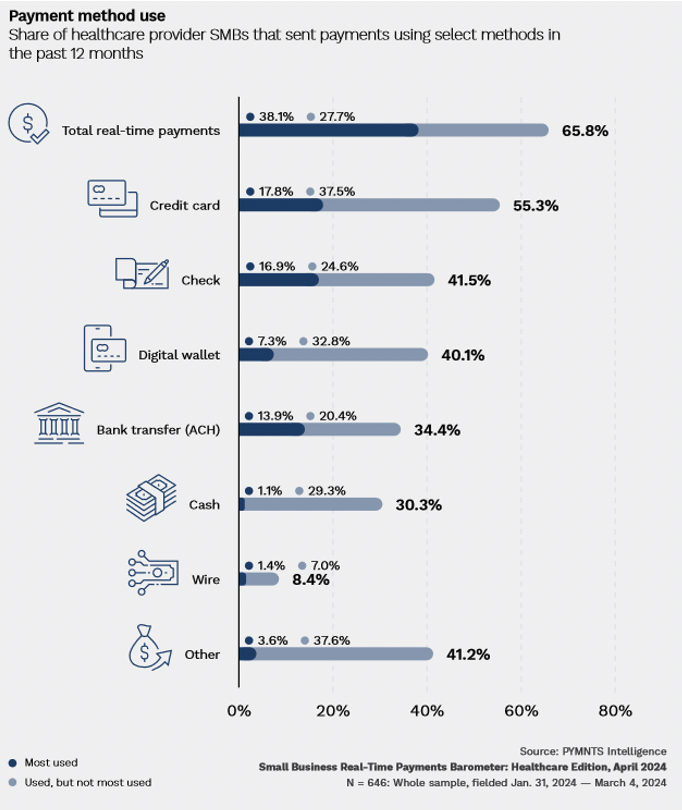 Four in 10 healthcare provider SMBs identified a real-time payment rail as their most used form of payment — more than twice the shares that said credit cards or checks — highlighting a preference for instant settlement in the healthcare space.
A variety of real-time payment options have become healthcare-industry SMBs’ go-to. In the lead is pay-by-bank, which 15% of healthcare provider SMBs said is their most used payment method. PayPal comes in second at 13%. Just 6.3% of healthcare providers use debit cards the most; last year, debit cards were used 41% of the time.
The shift suggests that debit cards may be losing their appeal to healthcare provider SMBs, perhaps now serving more as a backup payment rail and alternative to credit cards.
Going forward, real-time payments are expected to continue to gain traction with healthcare provider SMBs. Eighty-three percent of businesses surveyed said they have at least moderate interest in receiving real-time payments in the next year, while 68% said they are very or extremely interested. When it comes to sending money, 82% have moderate interest, while 64% are very or extremely interested.