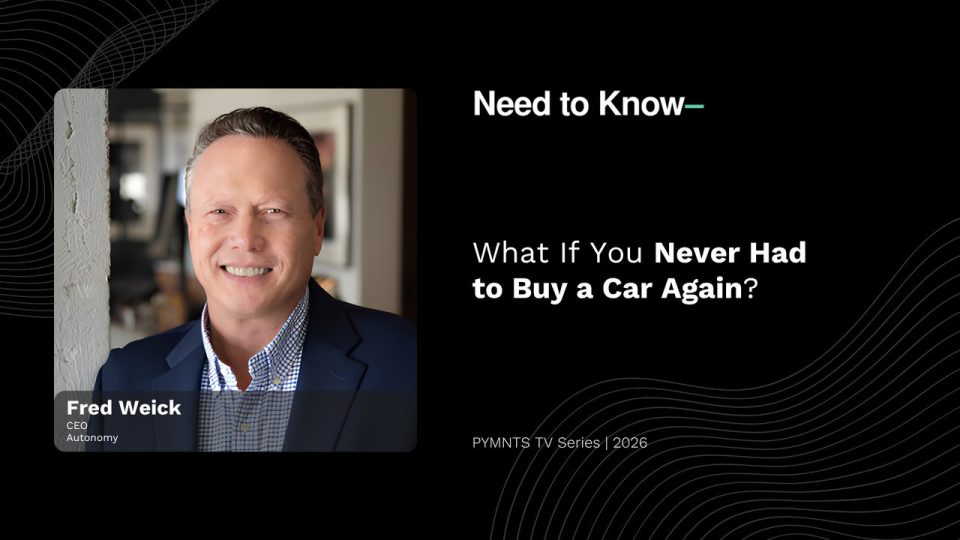
Autonomy CEO Fred Weick isn’t trying to talk Americans out of buying cars. He’s after the ones who can’t.
Weick took over Autonomy in June after more than 30 years at Mercedes-Benz and Daimler. He came in with a specific read on where vehicle subscriptions actually win, and it isn’t against the guy trading in his SUV every four years. It’s against the people for whom a three-year commitment is a practical problem.
Military families who relocate on orders. Students who need transportation for a semester or a school year. Expats who arrive in the United States without a domestic credit or driving history. Americans coming home after years abroad. Every one of them needs mobility. None of them fits neatly into a loan or a lease.
“The reality is that you can get into a vehicle, and you can get access to mobility as best suits your needs,” Weick told PYMNTS CEO Karen Webster.
That’s also why he pushes back on the Netflix comparison. A car subscription doesn’t mean choosing a different vehicle whenever the mood strikes. Customers can stay in the same vehicle for six, 12 or 24 months, or longer, and change when their circumstances warrant it. The flexibility is the product, not the novelty.
Autonomy combines the vehicle, the insurance, the maintenance and the other costs of having a car into one month-to-month payment. The vehicle stays Autonomy’s property when it comes from the company’s fleet. The subscriber never takes on the multiyear finance obligation attached to buying a financed car.
“If I lease a car, if I finance a car, or I purchase a car, every additional burden that comes with it is on my shoulders,” Weick said. “There are a lot of customers out there that don’t want that as part of that vehicle mobility solution.”
The Payment Model Is Doing the Underwriting
The mechanics of how a subscriber gets approved and how they pay are where the model separates itself from auto finance.
Autonomy doesn’t run what Weick described as a full traditional credit check. Its system looks at other indicators, including accident history and other potential red flags. Weick declined to detail the proprietary screening process, but he said a customer can get access to a vehicle in 10 to 15 minutes.
Payments run through credit cards, and they run in advance. Because the customer has already paid for the month ahead, a subscriber who doesn’t make the next payment hasn’t built up an unpaid vehicle balance the way a borrower does when they miss an auto loan payment, Weick said. If the payment stops, Autonomy can take the fleet vehicle back.
A subscriber who carries the charge on a credit card can still run up card debt. The obligation moves rather than disappearing. But it moves to an instrument the customer can walk away from in a month rather than one that runs for 60.
The Math Depends on What You Compare It To
A subscription can cost less than a conventional arrangement in some circumstances and more in others. Webster pressed Weick on where those economics meet.
“What’s the sweet spot?” Webster asked. “Is the longer term better? What’s the optimal term for both you and the consumer, and where do those collide?”
We’d love to be your preferred source for news.
Please add us to your preferred sources list so our news, data and interviews show up in your feed. Thanks!
Weick used his own cars to illustrate the arithmetic. He said he pays more than $500 a month for a leased vehicle plus $280 for insurance, putting his monthly expense near $800. An existing, already amortized vehicle in Autonomy’s fleet can run about $600 in that example. Other subscribers will make the opposite calculation and pay $900 instead of $800 because they put a value on the services and the flexibility that come with the subscription.
Those aren’t Autonomy averages or promised savings. They show how Weick said consumers should compare the products, which is against the combined cost and obligations of having the vehicle rather than against the advertised lease or loan payment alone.
Dealers Are the Fourth Dimension
Weick said his three decades on the manufacturer side are proving useful at the dealership level, where subscriptions have to compete for attention with products dealers already understand and already sell.
Autonomy can buy vehicles from dealers. Dealers can also use Autonomy’s technology to put their own inventory into subscription arrangements and deal directly with customers. Weick described subscriptions as a “fourth dimension” alongside purchasing, leasing and financing. Vehicles can come back to the dealer for service, and a customer who wants a different vehicle after six, 12 or 24 months comes back for another transaction.
Dealers aren’t generally leading with subscriptions, Weick said. The option gets used when the usual transaction doesn’t work, including for customers who can’t get conventional financing. Dealers have also used it to move inventory that’s sitting.
Employers Are the Next Opening
Weick said he is also looking past individual subscribers. He pointed to employees who receive vehicle allowances as a potential customer group.
“Today in the U.S., company car programs are not what they used to be in the sense that not everybody gets a car, but many companies do give their employees some allowance,” Weick said. “And that is a space that today we … can very much play in.”
As he told Webster, “once we have enough customers in the ecosystem … we can then be as creative as our customers need us to be.”
Watch the full interview with Autonomy’s Fred Weick to learn more about:
- Why Autonomy uses factors beyond a traditional full credit check to screen subscribers.
- How payments and vehicle recovery work when a subscriber doesn’t renew.
- Where Weick said he sees employer vehicle allowances fitting into the subscription market.
For all PYMNTS digital transformation coverage, subscribe to the daily Digital Transformation Newsletter.


 Add as Preferred Source