Small businesses increasingly see growth coming from the digital channels that extend their reach without requiring another storefront.
The PYMNTS Intelligence report “Why Main Street’s Digital Survivors Are Pulling Ahead: Four Years of Small Business Data” draws on 23 surveys conducted from July 2022 through February 2026. It finds that most small and medium-sized businesses (SMBs) are growing and confidence is near a four-year high.
We’d love to be your preferred source for news.
Please add us to your preferred sources list so our news, data and interviews show up in your feed. Thanks!
The gains remain uneven, but the data also point to practical opportunities in digital sales, broader payment acceptance and more purposeful use of financing. In February 2026, 51% reported higher revenue from a year earlier, while only 13% reported a decline. That down share stood at 22% in July 2022.
Key Points:
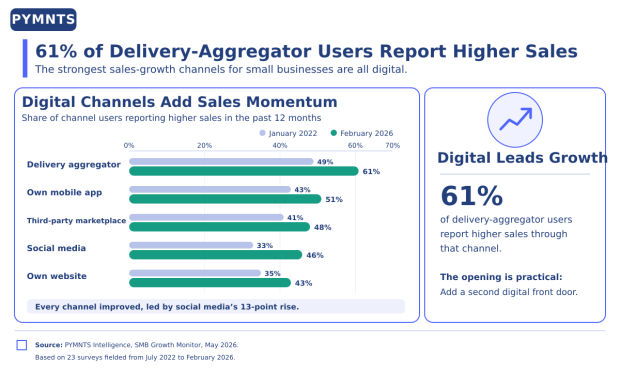
- Digital channels are carrying more sales. Among businesses using delivery aggregators, 61% reported higher sales through that channel, up from 49% in January 2022. Owned mobile apps followed at 51%, while 48% of marketplace sellers and 46% of social media sellers reported gains. These tools can serve as a second front door, giving an SMB more customer access without the cost of opening another location.
- Payment gaps create room to grow. Credit card acceptance has reached 79% both in stores and online, but newer methods remain uneven. SMBs accept Venmo online at a 41% rate compared with 36% in stores. Apple Pay stands at 32% online and 30% in stores, while buy now, pay later reaches 13% online and 8% at physical locations. Closing those gaps could give customers more ways to complete a purchase.
- Financing can support expansion. Of the SMBs that sought outside capital in February 2026, 37% did so as a strategy and 28% cited both strategy and necessity. Only 13% named an inability to secure financing as a threat to survival. That creates an opening for lenders and FinTechs to offer working-capital products tied to invoices or sales activity, with faster decisions and clearer business uses.
The report also shows why these opportunities carry urgency. Fifty-seven percent of SMBs now sell through their own websites, just 4 percentage points below the 61% that sell through physical stores. At the same time, businesses with more than $1 million in annual revenue posted average growth of 13.7% from 2020 levels, compared with 0.6% among the smallest firms. Overall confidence has also risen: 82% are very or extremely confident they’ll survive the next two years, up from 78% in July 2022. Smaller businesses can’t reproduce scale overnight, but they can adopt several practices associated with larger peers. Wider sales reach, more payment choice and smarter use of capital offer a workable route forward.


 Add as Preferred Source