Artificial intelligence has rapidly reshaped how consumers search, compare and decide what to buy. The next leap, agentic commerce, promises something bigger. Digital assistants that not only recommend products but complete purchases autonomously.
The promise is powerful. The reality is more complicated.
Consumers already expect AI to remove friction from the buying journey. They imagine a world where an assistant can handle everything from researching travel options to completing the payment and resolving any issues that arise. Yet the payments ecosystem that must support those experiences was largely designed for a different paradigm, one where a human is present to enter credentials, verify identity and confirm intent.
Closing that gap between expectation and capability is where companies like Visa see their strategic role emerging. Rather than simply reacting to the rise of AI agents, the company is working to prepare the payments infrastructure that will allow them to operate safely and at scale.
As Michele Herron, senior vice president and head of North America Value-Added Services at Visa, told PYMNTS CEO Karen Webster, the industry is still at the early edge of the shift. AI has already transformed how people gather information and perform tasks, she said, but when it comes to payments, “we’re just on the precipice” of true agentic commerce.
The Expectation Gap
The tension shaping agentic commerce is straightforward. Consumers are moving faster than infrastructure.
Today’s point-of-sale systems still assume a human completing the transaction. They expect card numbers, security codes and authentication steps that interrupt the experience, and make autonomous purchasing by an AI agent difficult.
At the same time, consumers increasingly expect commerce to feel invisible.
Many of those expectations are shaped by the digital environments people already inhabit. Social platforms and streaming services continuously learn preferences and anticipate interests. In commerce, consumers expect similar intelligence in systems that understand their habits, payment preferences and brand loyalties.
Yet the payment step often remains stubbornly manual.
Webster pointed to a familiar frustration. Consumers may book travel online only to encounter repeated prompts to confirm card details or enter promo codes or security codes. Even mobile checkout can stall if a preferred payment option isn’t available.
The result is abandonment.
“If I’m on my phone, and I want to buy, and my favorite payment button is not available, I’m out,” Herron said, describing the reality of modern consumer expectations.
From Digital Assistants to Commercial Agents
The fully autonomous AI shopping agent may still be emerging, but its building blocks are already visible.
Herron expects personal assistants that can participate in commerce to take shape within the next three years. They may begin with simple tasks, such as reordering household items, booking routine travel or comparing subscription options, before gradually expanding into more complex purchasing decisions.
The futuristic vision of robots handling every household chore might remain aspirational. But intelligent assistants embedded in everyday digital experiences are quickly becoming realistic.
The question for the payments ecosystem is how to support them.
If an AI agent is authorized to act on behalf of a consumer, payment networks must be able to confirm two things simultaneously: that the agent is legitimate and that the transaction reflects the consumer’s intent.
As Herron said, the goal is ensuring “the agent is authorized by me as the consumer, and that it’s consistent with my intent.”
That requires infrastructure capable of unifying identity, risk signals and contextual data in real time.
Infrastructure Built for an AI Economy
Visa’s strategy focuses on adapting existing payment capabilities so they can function in agent-driven environments.
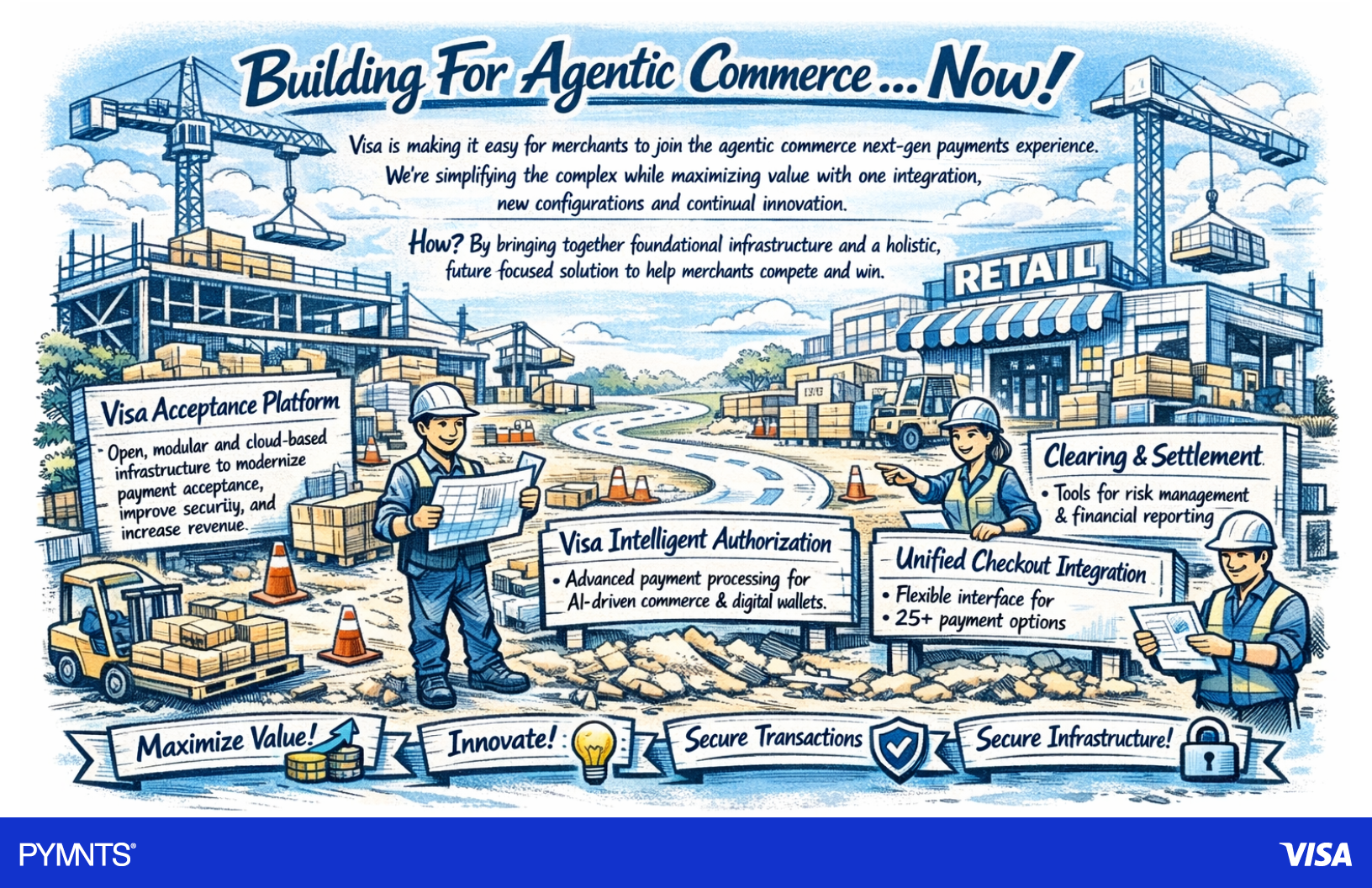
Herron pointed to the company’s unified checkout framework as a foundation. The orchestration layer consolidates multiple payment methods and embeds fraud controls, giving merchants a streamlined checkout experience.
In an agentic context, that architecture could allow AI assistants to interact with payments infrastructure in a similar way. Accessing payment credentials, preferences and authentication tools within a single framework.
Tokenization plays a central role in that vision.
Herron described tokenization as “the future of agentic” because a dynamic token can abstract sensitive credentials and automate authorization in a trusted manner.
By embedding intelligence within tokens, Visa can enable agents to execute transactions without exposing raw card data.
In practical terms, that means an AI assistant could complete a purchase using a tokenized credential linked to a consumer’s preferred payment method, spending limits and authentication rules.
Payments That Understand Context
Agentic commerce also changes how payment choices may be made.
If an assistant understands a consumer’s preferences and financial behavior, it could select the optimal payment method for a given purchase. For example, it could choose a rewards card for travel, an installment option for larger purchases or a digital wallet for speed.
We’d love to be your preferred source for news.
Please add us to your preferred sources list so our news, data and interviews show up in your feed. Thanks!
That intelligence could extend to loyalty and rewards as well.
Herron acknowledged that loyalty and card-linked offers today might feel disconnected from the purchase moment, describing them as “a little static … and a little reactive.”
With AI and tokenized data integrated into the payment experience, incentives could surface in real time, influencing purchase decisions rather than appearing after the transaction.
For merchants and issuers alike, that shift could strengthen engagement and deepen card usage.
Security in an Automated World
As payments become more automated, fraud prevention becomes even more critical.
In a traditional transaction, a consumer’s physical presence provides part of the authentication signal. In agentic commerce, that signal disappears.
Instead, networks must validate a complex set of indicators. That includes the authenticity of the agent, the legitimacy of the request and whether the purchase aligns with the consumer’s established behavior.
Visa’s approach layers cryptographic authentication with behavioral analysis to determine whether a transaction represents a legitimate automated action or a malicious attempt.
The goal is not simply verifying identity but verifying intent.
Turning Infrastructure Into an Accelerator
For Herron, the broader challenge facing the payments ecosystem is clear.
Across banks, FinTechs and merchants, innovation often collides with the limitations of legacy systems. Businesses want to deliver new experiences but find themselves constrained by infrastructure that was never designed for them.
“Infrastructure holds them back,” she said.
Visa’s long-term strategy is to change that dynamic by turning payments infrastructure from a constraint into a platform for innovation.
Or as Herron put it more simply, the goal is to “change it to be the accelerator.”
Agentic commerce may still be developing, but preparing the ecosystem for its arrival has already begun. If AI agents are going to shop on behalf of consumers, the payment systems behind those transactions must evolve alongside them.
Herron is careful not to oversell how quickly that future will arrive. Asked what she ultimately wants from AI, she joked that what she really needs is “a robot that cleans my house.”
That particular breakthrough may still be some time away.
But intelligent assistants that can help consumers research, decide and pay are moving much closer to reality.
For all PYMNTS AI coverage, subscribe to the daily AI Newsletter.


 Add as Preferred Source