However, the traditional touchscreen interfaces that dominate these devices often limit their usability. Now, a new frontier has emerged in the form of voice technology.
In the report “How Consumers Want to Live in the Voice Economy,” PYMNTS leveraged insights from a survey of nearly 3,000 U.S. consumers to examine their views and attitudes toward voice technology, especially how they use voice today, the friction they face and what they expect from voice technology in the future.
We’d love to be your preferred source for news.
Please add us to your preferred sources list so our news, data and interviews show up in your feed. Thanks!
One of the primary reasons consumers prefer voice technology over other methods is its ability to complete tasks faster, easier and more efficiently. Fifty-eight percent of consumers said using voice technology is easier and more convenient, while 54% said they appreciate its speed compared to typing or using a touchscreen. Additionally, 20% of consumers said voice technology is more secure, further enhancing its appeal.
Like the fascination with artificial intelligence (AI) technologies like ChatGPT, consumers are increasingly drawn to the “humanness” of voice technology, with some believing that voice assistants will eventually possess the same level of intelligence and reliability as humans. According to PYMNTS’ data, more than 60% of U.S. consumers trust that voice assistants will reach this level of sophistication, with 46% believing it will happen within the next five years.
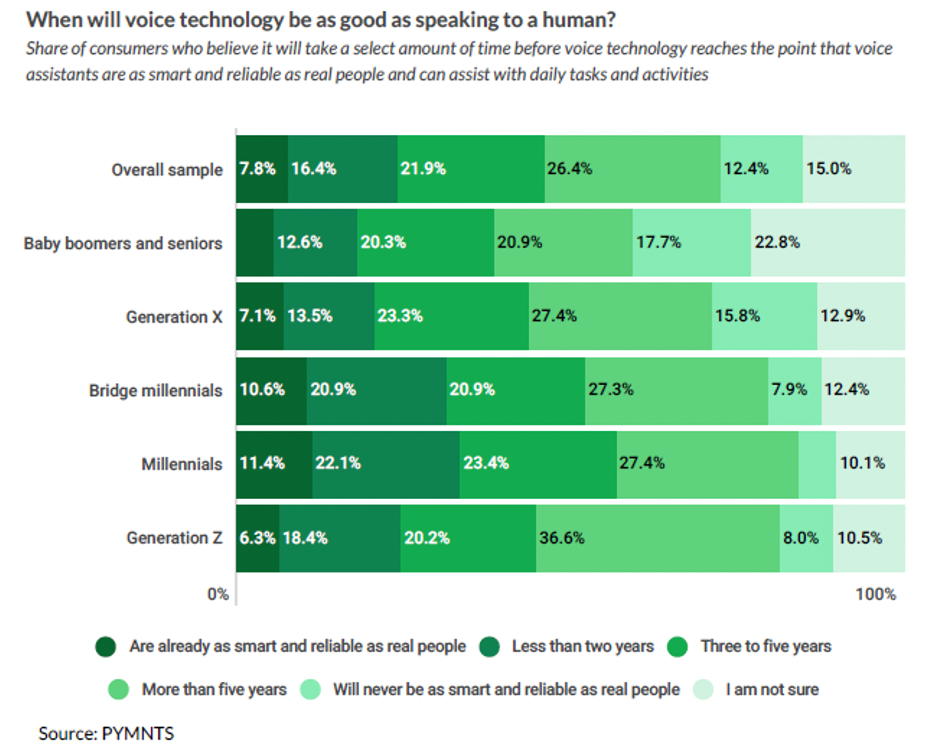
Drilling down, the data showed millennials exhibit the highest level of optimism regarding the future capabilities of voice technology. Fifty-seven percent of millennials said they think voice technology will match human intelligence and reliability within five years, and 11% said it already has.
On the other hand, baby boomers and seniors are more skeptical, with 18% doubting that voice assistants will ever reach that level of sophistication.
Optimism for voice assistants is not limited to mere belief, as 30% of Americans expressed a willingness to pay a monthly fee for a reliable and intelligent voice assistant.
Among millennials, this figure rose to 43%, while only 5.8% of baby boomers and seniors shared the same sentiment. Higher-income consumers also displayed a greater inclination to invest in voice assistants, with 31% of them willing to pay more than $10 per month.


 Add as Preferred Source