Fraud prevention has long been a defensive strategy for card issuers, but top-performing issuers are treating it as an offensive one.
They’re using tokenization and EMV chips not just to guard against threats, but to lock in long-term customer loyalty.
We’d love to be your preferred source for news.
Please add us to your preferred sources list so our news, data and interviews show up in your feed. Thanks!
 The PYMNTS Intelligence report “The Best-in-Class Modern Card Issuer: Meeting the Mandate to Align Fraud Prevention With Compliance Demands,” produced in collaboration with Visa DPS, surveyed 451 payments executives at U.S. bank and nonbank card issuers between December 2024 and January 2025. The findings reveal that issuers with higher customer lifetime value (CLTV) are investing in advanced fraud prevention tools that double as trust-builders, creating a competitive edge in a market where seamless security often determines which card stays top of wallet.
As digital fraud grows more sophisticated, the distinction between security and customer engagement is fading. Best-in-class issuers are recognizing that every swipe, tap or in-app checkout carries a reputational risk. By leading with tokenization and EMV, they are not only fortifying their defenses but also anchoring customer confidence, an intangible asset that can translate directly into higher lifetime value.
- Tokenization drives trust: Fifty-four percent of high-CLTV issuers cite tokenization as a critical factor when choosing an issuer processor, compared to 46% of the broader sample. Tokenization protects sensitive account data by replacing it with secure, one-time-use credentials, a safeguard that has become vital as digital wallets and in-app purchases grow.
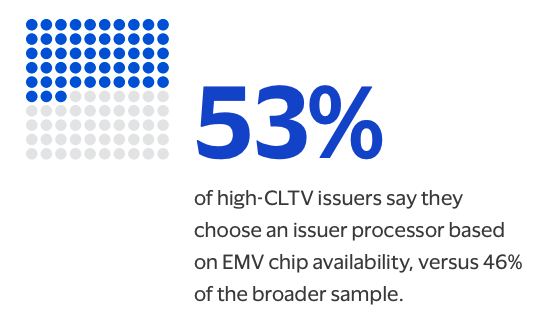
- EMV chips still matter: Fifty-three percent of high-CLTV issuers prioritize EMV chip availability, compared to 46% overall. Although an older technology, EMV remains essential in reducing card-present fraud and signaling reliability to cardholders at the physical point of sale.
- Fraud prevention as value creation: More than half of high-CLTV issuers cite fraud prevention, tokenization and EMV chips as decisive in processor selection. For these issuers, fraud controls are not just compliance tools. They are key drivers of engagement and revenue by enabling secure, repeatable transactions.
The most profitable issuers no longer view tokenization and EMV chips as table stakes. Instead, they are deploying these attributes as part of a broader customer experience strategy, making fraud prevention synonymous with brand trust.
See More In:
featured insights, Featured News, fraud, News, PYMNTS Intelligence, PYMNTS News, PYMNTS Study, Security, tokenization, Visa, Visa DPS


 Add as Preferred Source