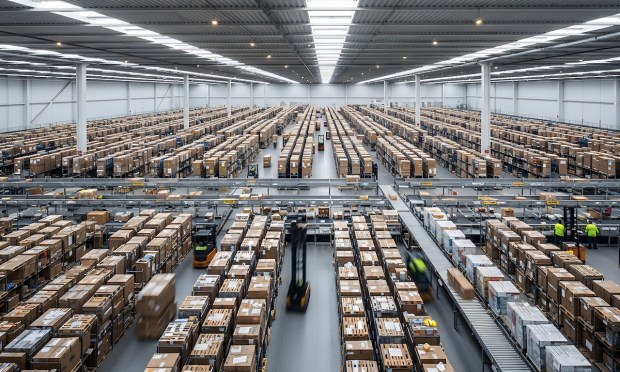
The company’s Series B funding round, announced Monday (Feb. 9), is designed to help businesses use physical AI to get a better picture of how goods move through their facilities.
“Inventory is one critical dimension of intralogistics. But between your receiving dock and your shipping dock, valuable operational data gets generated constantly. Most of it never gets captured. Digital systems track theoretical states,” Gather said in its announcement.
“Physical reality operates independently. That gap costs billions in delays, errors, and inefficiency,” the company continued. “This Series B funding expands the same Physical AI approach that solved inventory across your complete dock-to-dock operation.”
We’d love to be your preferred source for news.
Please add us to your preferred sources list so our news, data and interviews show up in your feed. Thanks!
According to the announcement, the company will use the $40 million to fund its global expansion as it deploys physical AI at hundreds of additional facilities in North America, Europe and Asia, with “every warehouse becoming part of an intelligent network.”
The company, which raised $17 million in a Series A-1 funding round in 2024, added that the financing will also help develop “the workflow intelligence and predictive AI capabilities that deliver complete dock-to-dock visibility,” while letting Gather expand its team.
A report on the funding by TechCrunch noted that because Gather’s underlying tech was developed years before the era of large language models, this is not the type of AI that an LLM uses.
“They’re not end-to-end neural networks,” said CEO and Co-founder Sankalp Arora. “They are classical Bayesian techniques, combined with neural networks.”
Those techniques, the report added, use probability-base methods to help computers interpret visual data. These systems let the technology learn by using data and past knowledge to make decisions, meaning they aren’t subject to hallucinations that plague LLMs.
Writing about the use of AI in the global logistics field late last year, PYMNTS argued that the technology had begun “breaking down the traditional constraint” of the industry: the need for more labor as business scales.
Logistics has historically been a business of scale: the more containers that are shipped, the lower per-unit cost. But traditionally, this scale meant adding workers, such as planners, coordinators and data processors. With AI, companies can now move thousands of containers with planning teams that would have had trouble managing hundreds five years ago.


 Add as Preferred Source