Real-time payments are starting to look less like a faster delivery truck and more like a digital receipt that arrives before anyone has to ask where the money went.
That is the point inside “Beyond Speed: The Strategic Value of Real-Time Payments,” the March 2026 Real-Time Payments Tracker Series from PYMNTS Intelligence and The Clearing House. The report argues that instant payments have moved past their early pitch of speed. The next advantage comes from precision, visibility and confidence. For banks and their corporate clients, that means knowing when funds settle, seeing where a payment stands and reducing the manual follow-up that often surrounds ordinary transactions.
The report shifts the conversation from “how fast” to “how certain.” A payment that moves in seconds can still create friction when teams lack confirmation, tracking or clear status information. Real-time payments address that gap by pairing instant movement of funds with immediate confirmation and predictable settlement.
Key Points:
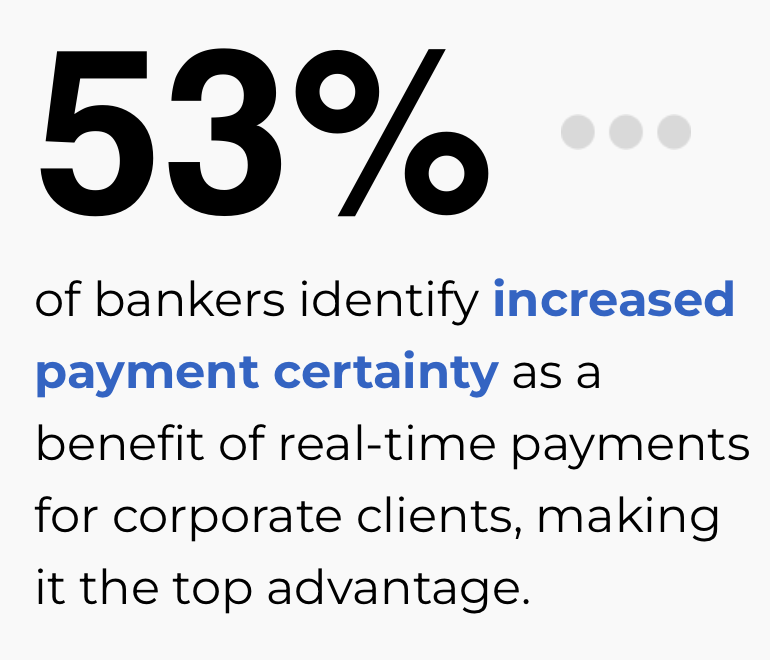
- 53% of bankers identify increased payment certainty as a benefit of real-time payments for corporate clients, making it the top advantage cited in the report. That certainty comes from immediate confirmation that funds have settled and cannot be reversed. For finance teams, it can reduce the gray area that often follows ACH payments, which can take days and remain subject to reversal.
- 28% of banks that offer instant payments exclusively to business customers cite improved payment tracking as a major advantage. Another 28% cite immediate confirmation as a key benefit. Those numbers show why corporates may view real-time payments as an operating tool, not just a payment rail. Tracking and confirmation help treasury, accounts receivable and customer service teams work from the same facts.
- 78% of financial institutions consider real-time payment confirmation and notification capabilities nonnegotiable, according to the report. That finding suggests that alerts and status updates are becoming core features rather than extras. They can reduce payment-status inquiries, cut administrative work and give both sides of a transaction a clearer view of what happened.
Other findings show why this certainty-driven approach has a wider business case. The report says 48% of financial institutions cite improved customer experience for corporate clients as a key benefit of real-time payments. Another 47% identify working capital optimization as a top benefit. The RTP network recently processed more than 1.8 million transactions totaling $5.2 billion in a single day, according to The Clearing House, and more than 1,000 banks and credit unions now participate in the network.
That scale points to an optimistic conclusion. Real-time payments are becoming standard infrastructure for companies that want fewer delays, fewer loose ends and better control over cash. Speed opened the door. Certainty may be what keeps businesses walking through it.