October. Some readers mark it on the calendar for the return of autumn and chilly temperatures. Others get ready for the full dose of sports that comes with the NFL season and the World Series. Here at PYMNTS, it’s B2B Payments time.
This year marks the seventh annual PYMNTS B2B Payments event, and the series is taking one of the hottest topics in business and putting it squarely in the corporate context. Get ready for The Agentic Enterprise, B2B version, running Oct. 5 through Oct. 14.
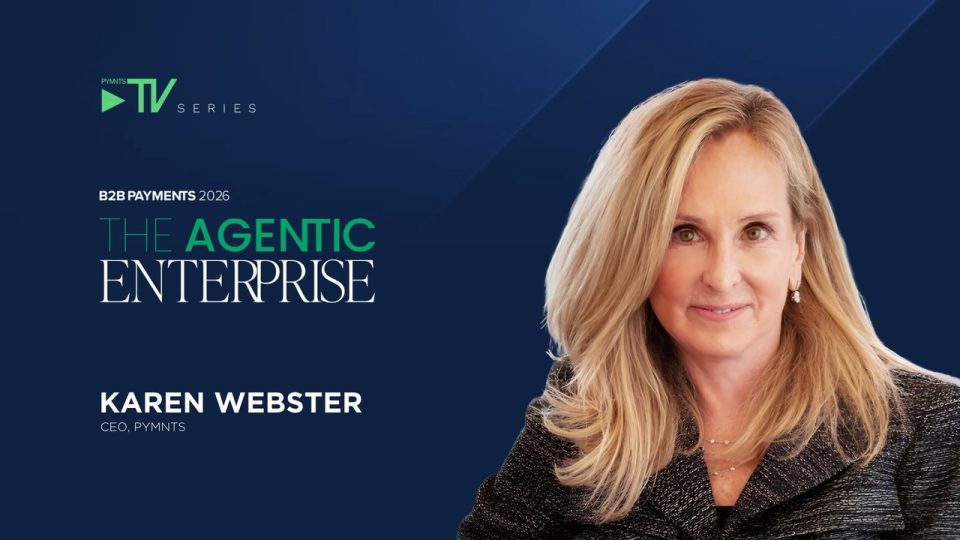
For PYMNTS CEO Karen Webster, the premise starts with a provocative observation: The agentic enterprise isn’t some distant destination.
“I think every enterprise is already agentic. And the question is how far along are they on that journey,” Webster told PYMNTS. “There’s always been a deployment of AI in these businesses. The question is how much is it embedded in the organization … and how many business activities does it really cover?”
That distinction will run through this year’s event. Companies have moved beyond simply experimenting with generative artificial intelligence. The bigger issue now is whether AI sits beside the work as another tool or becomes part of how the work itself gets done.
The Research Shows the Shift
PYMNTS Intelligence has been tracking 60 enterprise CFOs every month across a range of industries. Three years ago, Webster said, only about 30% of enterprises were fully using strategic, high-impact generative AI. Nine months after PYMNTS began the research, 90% of CFOs reported positive returns from AI, including in higher-risk areas such as cybersecurity.
The September research shows how quickly that adoption has widened. Enterprises now use AI across an average of seven of eight business functions, while 62% are spending more than $10 million on AI tools.
But deployment alone doesn’t make an enterprise agentic. PYMNTS examined 437 AI deployments and found only 20% were actually embedded in workflows. The payoff rose sharply when companies crossed that line. Just 25% of surveyed firms broadly said AI had already paid off. That climbed to 55% among companies with one or two embedded functions and 93% among those with three or more.
Webster sees three factors separating the companies moving fastest. First, AI must run inside the business rather than next to it. Second, authority and autonomy must be earned through experience. Third, companies will need to invest in what Webster calls the “plumbing” behind AI, including data, permissions and workflows.
“The opportunity is not to just use AI as a sidekick or a sidecar, but to really embed it inside the business,” Webster said. “With trust and experience, you become more comfortable making it part of your workflow, not something that is a bolt-on to what you already do.”
That deeper integration can expose new problems. Webster said companies using AI more extensively encounter more barriers because agents begin touching core systems involving data, permissions and workflow. That could shift more investment toward the infrastructure that lets agents operate safely and effectively.
When Agents Start Negotiating Economics
B2B payments may offer one of the clearest examples of what comes next.
Historically, buyers and suppliers negotiated payment terms, invoices established deadlines and payments followed a schedule. Agents could make that process much more dynamic.
Webster said an agent could evaluate which payment method produces the best economic result for a particular buyer and supplier rather than simply following a preset payment preference. That could also put pressure on business models that profit from friction, including late fees, slow float and established acceptance economics.
In other words, agents could eventually negotiate more than workflow. They could negotiate economics. That possibility raises the stakes when software gains permission to commit or move money.
“You build trust with experience,” Webster said. “You basically have mandates that have hard edges, whether they’re dollar limits, counterparty limits, rails … there has to be a guardrail. There has to be authority and autonomy that comes with what the CFO is willing to permit.”
We’d love to be your preferred source for news.
Please add us to your preferred sources list so our news, data and interviews show up in your feed. Thanks!
Identity will be another critical control. Businesses need to know who an agent represents, verify the account receiving the money and continually understand why the agent made a decision. Four in 10 CFOs in PYMNTS’ research expect AI to explain policy changes and violations. Webster also pointed to the need for escalation, reversibility and a way for humans to stop an agent in midflight. The accountability, she said, still belongs to the company.
“You should never grant an agent any more authority than you’re willing to explain to your board if something were to go wrong,” Webster said.
What’s Coming at B2B Payments 2026
This year’s series will use real-world scenarios and role-playing rather than relying only on traditional panel discussions. Executives will be asked to put themselves in the shoes of business leaders deciding what authority to delegate to agents, where people should intervene and what happens when something goes wrong.
The schedule, with all sessions at noon Eastern, includes:
Oct. 5: “Welcome to B2B Payments 2026” with Karen Webster.
Oct. 6: “Stopping B2B Fraud Before AI Moves the Money” with Bottomline’s Katie Elliott.
Oct. 7: “How Payments Turn AI Into Action” with WEX’s Ryan Taylor.
Oct. 8: “Building a Trusted Foundation for Agentic AI” with Entrust’s Anudeep Parhar.
Oct. 12: “Beyond the Rails: The Infrastructure Powering Payment Partner Ecosystems” with Maverick Payments’ Guy DiMaggio.
Oct. 13: “Trusted Data Comes Before AI Payment Decisions” with Tungsten Automation’s Danielle Weinblatt.
Oct. 14: “Before AI Moves Money, It Must Earn Authority.”
Register for B2B Payments 2026: The Agentic Enterprise.


 Add as Preferred Source