Moving money across borders may be one of the last steps in an international payment. Getting the money ready to move can take considerably longer.
Before a multinational company pays an overseas supplier, its finance team often needs to verify the counterparty, reconcile an invoice against a purchase order, determine the currency exposure, check sanctions restrictions, validate banking instructions and establish which entity is authorized to release the funds.
Google’s Thursday (Oct. 8) introduction of a universal Gemini agent capable of coordinating tasks across enterprise applications, however, raises a new question for corporate treasury: How much of that fragmented work can now be delegated to AI?
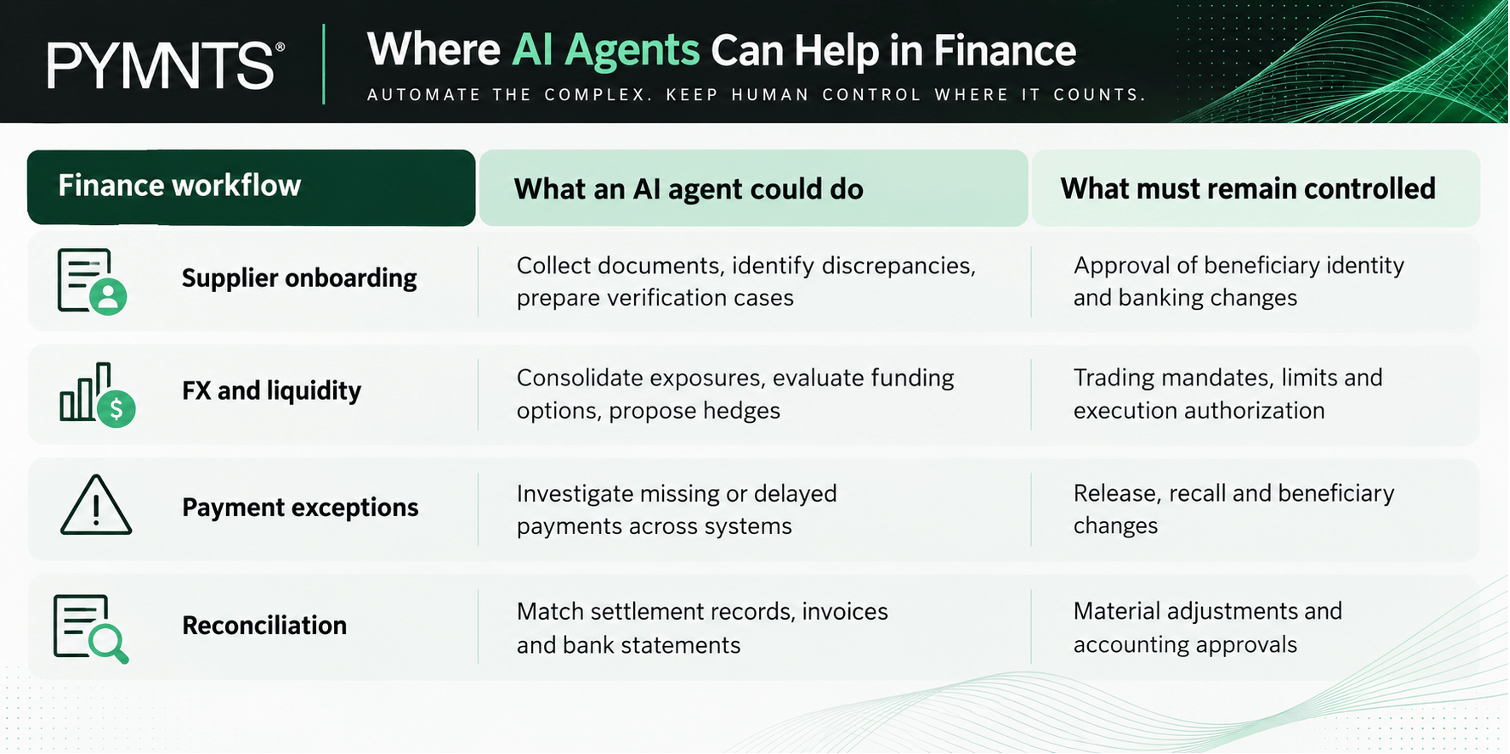
An AI agent might discover that a supplier payment is stalled because beneficiary information is incomplete. It could retrieve the invoice, compare bank account details, identify the discrepancy and prepare corrected instructions. But if an intermediary bank requires additional compliance checks, or the receiving institution cannot process the transfer until its next settlement window, the agent can’t just automate the obstacle away.
As a result, the first major productivity gains from agentic cross-border finance may come from eliminating the manual work between financial systems, not replacing payment rails.
Read also: Corporate Cash Is Global in Theory, Trapped in Practice
The Difference Between Payment Friction and Payment Failure
Cross-border payments are often described as a speed problem. In practice, they are also an information, coordination and accountability problem.
Each participant operates within its own technical architecture, compliance obligations and processing schedules. A single international commercial payment may involve the originating company’s enterprise resource planning (ERP) platform, treasury management system, originating bank, correspondent institutions, foreign exchange providers and beneficiary bank.
And when something goes wrong, the corporate finance team may have visibility into only a fraction of the transaction’s journey. Much of the reconciliation and matching work is procedural, but it is rarely contained within a single application.
That means an international payment can settle quickly and still be expensive to administer. Conversely, a payment delayed by an external compliance review can be operationally well managed if the payer identifies the issue promptly and communicates accurately with the beneficiary.
“More methods don’t inherently mean ‘better,’ because each one that you add to your payment stack will carry overhead to the stack,” Nick Daley, director of product management at Spreedly, told PYMNTS. “Some are more relevant than others in certain markets.”
We’d love to be your preferred source for news.
Please add us to your preferred sources list so our news, data and interviews show up in your feed. Thanks!
Read more: Currency Just Became Treasury’s Newest Superpower
Better AI Won’t Fix Broken Payment Infrastructure
The strongest early applications of agentic AI in cross-border treasury may therefore be the least dramatic.
Automated beneficiary-data validation could reduce avoidable rejections. Intelligent reconciliation could match incoming funds against invoices despite inconsistent references. Exception-management agents could identify recurring problems by bank, supplier or payment corridor.
The PYMNTS Intelligence report “The Cross-Border Opportunity: How Payments Innovation Can Help SMBs Go Global“ in May found 57% of small- to medium-sized businesses (SMBs) in the United States buy goods or inputs from overseas suppliers. The report also found 43% of SMBs with global suppliers identify faster payment processing and settlement as their top improvement priority, compared with 37% citing lower fees or better foreign exchange rates.
The longer-term opportunity may be greater. As financial institutions improve application programming interfaces (APIs), harmonize messaging and extend settlement availability, AI agents could coordinate more sophisticated payment workflows across providers.
“I think every enterprise is already agentic, and the question is how far along are they on that journey,” PYMNTS CEO Karen Webster said in a Tuesday (Oct. 6) thought leadership piece for the seventh annual PYMNTS B2B Payments event. “There’s always been a deployment of AI in these businesses. The question is how much is it embedded in the organization … and how many business activities does it really cover?”
Of course, success is not guaranteed. An agent that misclassifies a payment exception creates additional work. An agent that changes beneficiary instructions or releases funds without adequate authorization can create financial losses, fraud exposure and compliance violations.
The PYMNTS Intelligence report “Tech on Tech: How the Technology Sector Is Powering Agentic AI Adoption“ revealed in August 2025 a widening agentic readiness gap between tech companies and firms in goods and services, with 75% of tech firms reporting they were extremely familiar with agentic AI, versus 33% of goods firms and 38% of services firms.
For all PYMNTS B2B and AI coverage, subscribe to the daily B2B and AI newsletters.



 Add as Preferred Source