A company can automate routine supplier payments while requiring human approval for unusually large payments or transactions outside its normal markets.
For Emily Nash-Walker, senior director of product strategy at Tungsten Automation, that is where the next phase of accounts payable automation takes shape. Routine transactions such as rent, utilities or payments to established suppliers can pass through preset controls. A large payment, a supplier in an unfamiliar country or an exception to normal activity may still call for additional review.
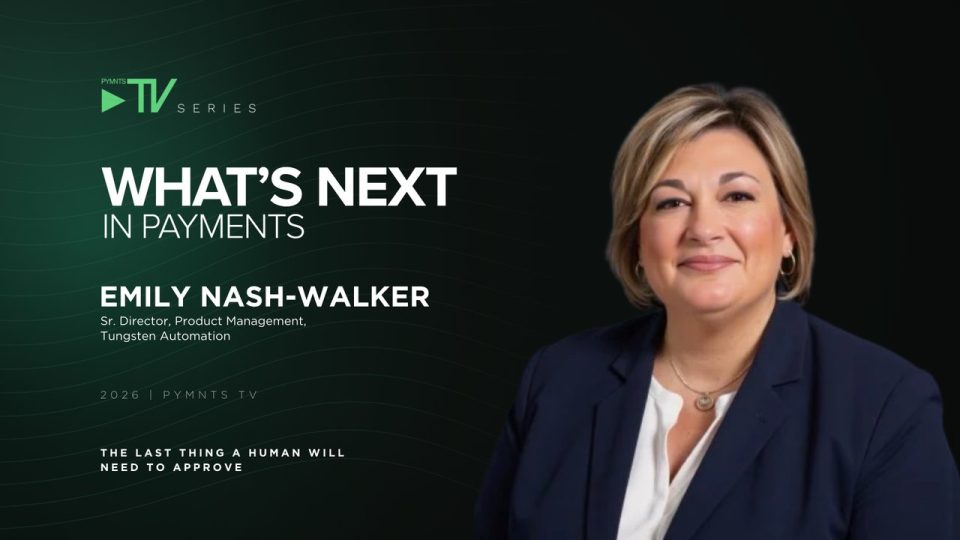
In an October “What’s Next in Payments” interview with PYMNTS, Nash-Walker said companies need to decide where human review serves a specific control rather than treating review itself as the control.
“If you’re doing it for every single transaction, I think you’re adding a lot of time — and time is money — into the process,” she told PYMNTS. A recurring payment to a known counterparty can be automated within defined tolerances. Nash-Walker said a payment above a specified amount in a country where the company doesn’t normally pay suppliers may warrant examination. The decision depends on the transaction, its context and the controls surrounding it.
Geography adds some complexity to fund flows. Nash-Walker pointed to Brazil as an example of how payment automation has to accommodate local requirements. She said changes expected there will affect how taxes are handled alongside payments, while Poland and France are also moving through regulatory changes that companies will have to incorporate into their processes.
At the same time, automation has to preserve the records needed for tax reviews, routine audits and other oversight. Nash-Walker said businesses can use traceability, reporting and designated stops to maintain those controls without requiring an employee to inspect every transaction.
From Rules Engines to Agents
We’d love to be your preferred source for news.
Please add us to your preferred sources list so our news, data and interviews show up in your feed. Thanks!
Artificial intelligence changes how those controls are maintained. Nash-Walker expects businesses to rely on automation, AI and business rules to handle ordinary activity at scale, reserving people for exception handling. She compared the evolution with Sarbanes-Oxley compliance, which moved from a major operational adjustment into a standard part of doing business.
“I really don’t envision [a time] where we’re going to have auto-approvals on everything,” Nash-Walker said, pointing to payments of $100,000, $250,000 or $1 million as transactions where a CFO may still want someone to review why the money is leaving the company.
Agentic AI could alter the work surrounding that final decision. Nash-Walker told PYMNTS that agents may eventually take over functions now assigned to rules engines, with auditability and traceability remaining essential.
She offered up the example of a business operating across all 50 states. If one state changes a requirement, an agent could adjust for that jurisdiction rather than requiring developers to revise a larger set of rules manually.
“We’re going to move away from rules engines specifically, and we’re going to move more toward agents that are auditable and traceable,” she added.
Tungsten’s role, as Nash-Walker described it, is to give customers the ability to determine when rules apply, when AI is used and when automation is permitted. The approach leaves the limits of automation with the enterprise rather than treating AI as having unrestricted authority over the workflow.
Removing manual steps also doesn’t remove responsibility. Asked who should be accountable when an automated system makes the wrong call, Nash-Walker placed responsibility with the person responsible for signing off on the transaction, while noting that the responsible party and applicable requirements can differ across jurisdictions.
“Ultimately, it comes down to a transaction level,” she said. “A system is only as good as the rules that you put in place.”
Watch the full interview with Emily Nash-Walker to hear:
- How companies can decide which supplier payments still warrant human approval.
- How country-specific requirements affect automation.
- Why she expects agents to take work from rules engines.


 Add as Preferred Source