Buy now, pay later has moved well beyond its original role as an alternative payment method at checkout. It is shaping how retailers present products, influence purchase decisions and guide shoppers through the buying process before a payment screen ever appears.
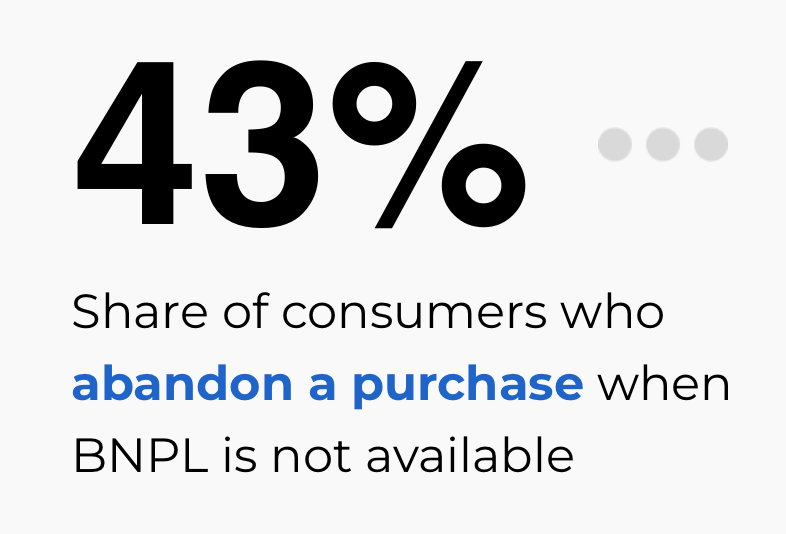
That evolution is becoming harder for merchants to ignore. PYMNTS Intelligence research with PayPal found that 43% of consumers abandon a purchase when BNPL is unavailable. If nearly half of prospective buyers are prepared to walk away because financing is missing, retailers must reconsider where flexible payment options appear within the customer journey rather than treating them as a final checkout feature.
The findings indicate that payment flexibility is becoming part of merchandising. Consumers are evaluating affordability while comparing products, not simply after deciding to buy. That distinction matters because purchase intent often forms long before shoppers reach a checkout page.
The research also suggests BNPL influences merchant selection. Thirty-eight percent of consumers say BNPL availability affects where they order food delivery, while 37% say it influences travel bookings. Among younger consumers, the effect is considerably stronger. Sixty-two percent of millennials and 49% of Generation Z consumers report that BNPL availability affects their choice of travel merchant. Those figures point to a broader shift in shopping behavior, where financing joins price, assortment and convenience as part of the purchasing decision.
We’d love to be your preferred source for news.
Please add us to your preferred sources list so our news, data and interviews show up in your feed. Thanks!
The spending implications are equally notable. Research cited in the report shows that 81% of consumers spend more when using BNPL. Conversely, when flexible payments are unavailable, 42% choose a lower-cost product or service instead.
Merchandising Begins Before Checkout
The report argues that merchants often miss the most influential point in the shopping journey by introducing BNPL only during payment. Earlier presentation, including product pages, category pages and shopping carts, allows consumers to evaluate affordability while they are still comparing options instead of after they have already committed to a purchase.
Merchants using upstream messaging and Pay Later button placement recorded a 4.4% increase in overall sales, illustrating that visibility itself can affect purchasing decisions. While those figures come from PayPal data, the broader lesson extends beyond any single provider: payment placement can alter shopping behavior before checkout begins.
Execution also matters once consumers decide to finance a purchase. Although 81% describe BNPL as convenient or very convenient, 79% report abandoning BNPL checkouts at least occasionally because of unnecessary friction, including lengthy approval processes, confusing payment terms and repeated data entry. Those findings suggest that offering instalment payments alone does not guarantee stronger performance if the experience introduces avoidable obstacles.
The long-term implications extend beyond individual transactions. According to the research, 57% to 87% of consumers across spending categories say BNPL availability strongly influences where they shop regularly. PayPal also reports that 74% of global purchases made through its Pay Later option come from repeat buyers. Together, those findings suggest that merchants may generate greater value when BNPL contributes to ongoing customer relationships rather than isolated conversions.
Retailers will need to view BNPL less as a payment feature and more as part of merchandising strategy. As adoption becomes commonplace, simply offering instalment payments is unlikely to distinguish one merchant from another. The differentiator lies in how thoughtfully flexible payments are incorporated into product discovery, purchasing decisions and the overall customer experience.


 Add as Preferred Source