A steady job still gives many consumers confidence, but the latest data shows that confidence alone is no longer enough to keep financial resilience intact.
That’s the central takeaway from “Why Job Security No Longer Shields Paycheck-to-Paycheck Consumers,” a June 2026 PYMNTS Intelligence Data Book based on the PYMNTS Consumer Expectations Index. The report paints a mixed but revealing picture of household finances.
Consumers generally still feel good about their employment prospects, yet the households under the most strain are showing weaker resilience, lower emergency readiness and less room to absorb a financial shock. In other words, job security is starting to look like a strong engine in a car with very little fuel in the tank. It helps, but it does not guarantee the trip will go smoothly.
We’d love to be your preferred source for news.
Please add us to your preferred sources list so our news, data and interviews show up in your feed. Thanks!
Roughly two in three Americans lived paycheck to paycheck in early 2026. Within that group, about 40% to 45% said they could pay their monthly bills comfortably, while 20% to 25% said they consistently struggled to do so.
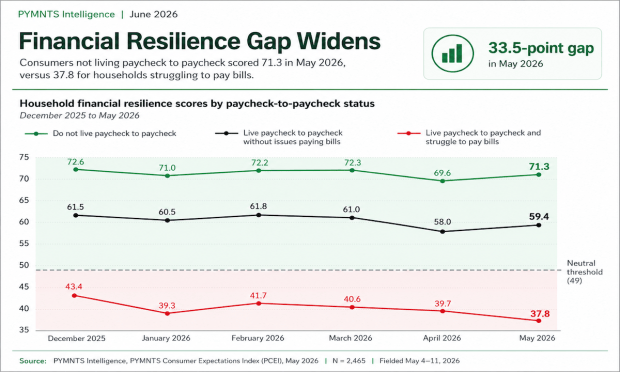
The report’s financial resilience subindex showed the widest divide. Consumers not living paycheck to paycheck scored 71.3 in May, while those living paycheck to paycheck and struggling to pay bills scored 37.8, a 33.5-point gap. That spread has widened since December, suggesting that the most stressed households have less room to manage bills, debt and unexpected expenses.
The biggest weakness showed up in emergency preparedness. Households struggling to pay bills scored just 24.5 on emergency readiness, compared with 85.4 for consumers not living paycheck to paycheck. That gap helps explain why even modest disruptions can hit some households much harder than others.
The encouraging part is that job confidence has not collapsed. In fact, labor sentiment remained the strongest part of the main index. Consumers living paycheck to paycheck and struggling to pay bills scored 79.2 on job security, which suggests they generally feel safe in their current positions. But that same group scored only 36.3 on job mobility, showing little confidence that they could replace lost income quickly.
The survey also found that all three household groups slipped below the neutral threshold on the macroeconomic and buying climate measure by May, a sign that broader economic pressure is being felt widely. Even so, the data points to a clear path forward. Households appear to need more than stable employment. They need tools that build savings, improve cash flow and create a workable cushion for emergencies.
That is a difficult challenge, but it is also a practical one, which means financial institutions and employers still have room to help consumers strengthen their footing.
At PYMNTS Intelligence, we work with businesses to uncover insights that fuel intelligent, data-driven discussions on changing customer expectations, a more connected economy and the strategic shifts necessary to achieve outcomes. With rigorous research methodologies and unwavering commitment to objective quality, we offer trusted data to grow your business. As our partner, you’ll have access to our diverse team of PhDs, researchers, data analysts, number crunchers, subject matter veterans and editorial experts.


 Add as Preferred Source