For many hourly workers, the most useful financial tool may not be a bigger paycheck, but a clearer view of when that paycheck will arrive and how large it will be.
That is the practical takeaway from “The Schedule Shock: How Unstable Hours Turn Paychecks Into Guesswork,” the May 2026 PYMNTS Intelligence Wage to Wallet Index, produced in collaboration with WorkWhile. The report examines how employer-driven schedules affect Labor Economy workers, defined as hourly, gig, seasonal or shift-based workers earning no more than $25 an hour and typically less than $50,000 a year.
While much of the report shows how unstable hours create financial strain, the third key finding points to a more constructive path. The tools that could help already exist, but too few workers can use them.
We’d love to be your preferred source for news.
Please add us to your preferred sources list so our news, data and interviews show up in your feed. Thanks!
Those tools include predictable weekly schedules, advance notice, guaranteed minimum hours, premium pay for sudden changes and faster access to earned wages. Together, they work like guardrails on a mountain road. They do not remove every turn, but they make the trip safer and easier to navigate.
The opportunity is clear in the data:
- 46% of Labor Economy workers say their employer offers a stable and predictable weekly schedule, compared with 56% of non-Labor Economy workers.
- 21% of Labor Economy workers say their employer gives at least one week’s notice of schedule changes, while 32% report guaranteed minimum hours per week.
- 11% of Labor Economy workers have access to on-demand pay or early access to wages already earned, the same share as non-Labor Economy workers.
That last figure may be the most important for banks, FinTechs and workforce platforms. Early wage access can be a convenience for a worker with predictable pay. For someone whose hours change with little warning, it can serve a different purpose. It can help keep a bill from becoming late, preserve a small savings cushion or reduce reliance on credit when income arrives later than expenses.
The report also shows that the need extends beyond wage access. Only 17% of Labor Economy workers receive overtime or premium pay for short-notice changes, compared with 25% of non-Labor Economy workers. Just 10% say they are paid when shifts are canceled or cut short. These protections can create an income floor when schedules change, giving workers more confidence that a sudden shift in hours will not immediately disrupt the household budget.
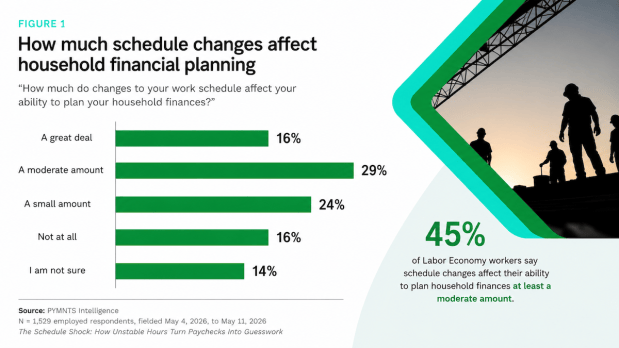
Other findings show why these fixes could have broad effects. More than 6 in 10 Labor Economy workers experienced at least one financial consequence from schedule changes in the past 90 days. Twenty-six percent earned less than expected in a pay period, 25% missed or were late on a bill, 20% dipped into savings or an emergency fund, and 20% borrowed money or used credit they had not planned to use.
The optimistic reading is that this is not only a wage problem. It is also a design problem. Better scheduling systems, clearer notice and faster access to earned wages could help workers plan with more confidence. For employers and financial providers, that creates a chance to turn an unstable paycheck into something closer to a usable financial plan.


 Add as Preferred Source