For most of the cryptocurrency industry’s history, lawyers occupied a familiar role: identify risks, interpret regulations and tell companies what they couldn’t do.
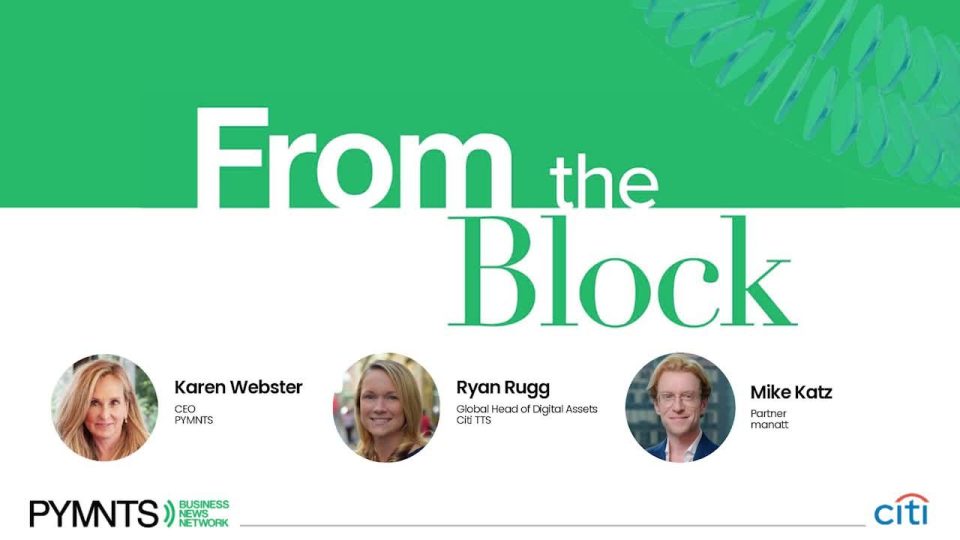
But Mike Katz, partner in Manatt’s Financial Services Group, told PYMNTS CEO Karen Webster and Ryan Rugg, global head of Digital Assets TTS, Citi, that he believes that era is ending.
“Operators, business folks, they want a decision. They want a recommendation. They want to understand what they need to do,” Katz said during the latest episode of “From the Block.” “You need to have a perspective. You need to have a point of view.”
Having spent years on both sides of the table, as a chief legal officer inside a crypto-focused venture capital firm and as a lawyer advising digital asset companies, Katz has watched the industry mature from a largely speculative ecosystem into one focused on building lasting financial infrastructure.
The shift, he said, demands a different kind of legal adviser.
“I was the client for four years,” Katz added. “When you’re on the business side and when you’re sitting at the table around business and operational leadership, you get a different experience than you get when you’re a lawyer in a law firm.”
That doesn’t mean minimizing risk. It means contextualizing it. Too often, lawyers deliver lengthy memos that carefully outline every possible risk without clearly stating what a company should actually do next.
“Here’s what I would recommend based on the context, the facts, the law, the regulations,” Katz said. “And by the way, here are the risks associated with this decision.”
It’s a philosophy that mirrors how operators themselves make decisions: imperfect information, finite time, forward motion. That perspective has become more valuable as stablecoins, tokenized assets and digital payment rails move from experimentation toward regulated infrastructure.
The View From Both Sides of the Crypto Table
Digital asset regulation remains a moving target. Businesses are being asked to make five- and 10-year strategic investments while the underlying rules continue to evolve.
“It’s almost a full-time job to keep up with all the changes on the legislative front, on the regulatory front, on the technological front,” Katz said.
The industry’s future, against this backdrop, will depend less on technological breakthroughs than on whether businesses, regulators and institutions can work together to create systems people trust.
“It’s not like, ‘This is how a regulator has interpreted this for the last 40 years.’ It’s more like, ‘These rules are not yet final, but we think it’s going in this direction,’” Katz said, adding that, contrary to popular stereotypes, most companies are not looking to race ahead recklessly.
The passage of the GENIUS Act is reinforcing that transition. While rulemaking remains ongoing and questions remain around broader market legislation, the law provides a foundation that businesses can begin planning around. Many are already moving quickly enough to capture opportunity, but carefully enough to avoid becoming a cautionary tale.
Speedboats, Battleships and the Future of Finance
For much of its history, the digital asset industry has been consumed by a single question: Can blockchain technology transform financial services?
Today, that question is largely settled. The technology works, and it does in fact hold transformative potential. The more pressing question now is whether the industry can build a regulatory and operational framework capable of supporting mainstream adoption of digital assets and while scaling enterprise blockchain integration.
Two operating models are coming to dominate the possible answers to that question. On one side are startups — fast-moving, opportunistic, willing to navigate ambiguity. On the other are global financial institutions carrying decades of regulatory expectations, risk management obligations and customer trust.
During the discussion, Citi’s Ryan Rugg described the contrast through the lens of enterprise responsibility, noting that large financial institutions cannot afford experimentation that compromises safety.
“We take that very seriously,” Rugg said of safeguarding customer assets. “Whether it’s traditional assets or it’s DeFi or it’s crypto, it doesn’t matter.
We’d love to be your preferred source for news.
Please add us to your preferred sources list so our news, data and interviews show up in your feed. Thanks!
“We want to make sure that not only are we abiding by the regulations and the rules, but that what we’re doing is 100% going to be safe,” she added.
“The system is stronger with the large institutions, with the startups and the newer entrants that push innovation in a different way,” Katz said. “I think each complement the other.”
The metaphor that emerged throughout the conversation, of startups as speedboats and major banks as battleships, is a telling one. The speedboats identify new routes. The battleships institutionalize them. Both are necessary if digital assets are to become part of mainstream financial infrastructure.
Why Guardrails and Universal Acceptance Matter Most Today
Perhaps the most revealing moment came near the end of the conversation, when PYMNTS CEO Karen Webster asked Katz what lessons the industry should take from past failures.
After nearly a decade watching cycles of boom, bust, enforcement actions, bankruptcies and regulatory investigations, Katz’s answer was strikingly pragmatic.
“You realize how important good guardrails are,” he said, noting that America’s historical advantage in capital formation stems from trust, transparency and regulatory reliability — not from the absence of rules.
And while U.S. banking regulators work through implementation of the GENIUS Act, financial institutions are confronting the practical question of where, if stablecoins become largely interchangeable products, competitive advantage will actually reside.
Treasurers, CFOs and corporate finance teams do not want separate operational stacks for digital assets. They want digital assets to integrate seamlessly into existing treasury management systems, ERP platforms, accounting workflows and risk frameworks.
“What is not talked about enough in the market is the backwards compatibility with traditional assets,” Rugg said. “If they have to set up a separate wallet and manage the keys and manage the node and manage the assets and do all the accounting around it, it’s going to be too complex.”
The goal, according to Rugg, is to create an environment where businesses can move between traditional money, tokenized assets and stablecoins without fundamentally changing how they operate.
“How do we make it fully backwards compatible for our clients?” she asked.
After all, as Webster noted, digital assets face a unique competitive challenge in that they are attempting to replace a payment system that already delivers near-frictionless experiences for most consumers.
“You don’t even think about it,” Webster said of card payments and digital wallets. “You have no idea what happens under the hood. But you know that it is absolutely flawless. It works every single time.”
“If the products are interchangeable,” Katz said, “then you win on being the default inside the apps that people already use.”


 Add as Preferred Source