Stablecoins and exchanges once solved each other’s biggest problem. Now they are each trying to compete for the other’s role in the financial value chain.
The Tuesday (June 30) announcement that more than 140 companies from FinTech, financial services and institutional cryptocurrency joined a consortium called Open Standard to launch a new dollar-backed stablecoin, Open USD (OUSD), shows how much stablecoin issuers and crypto exchanges have diverged from their once-parallel paths.
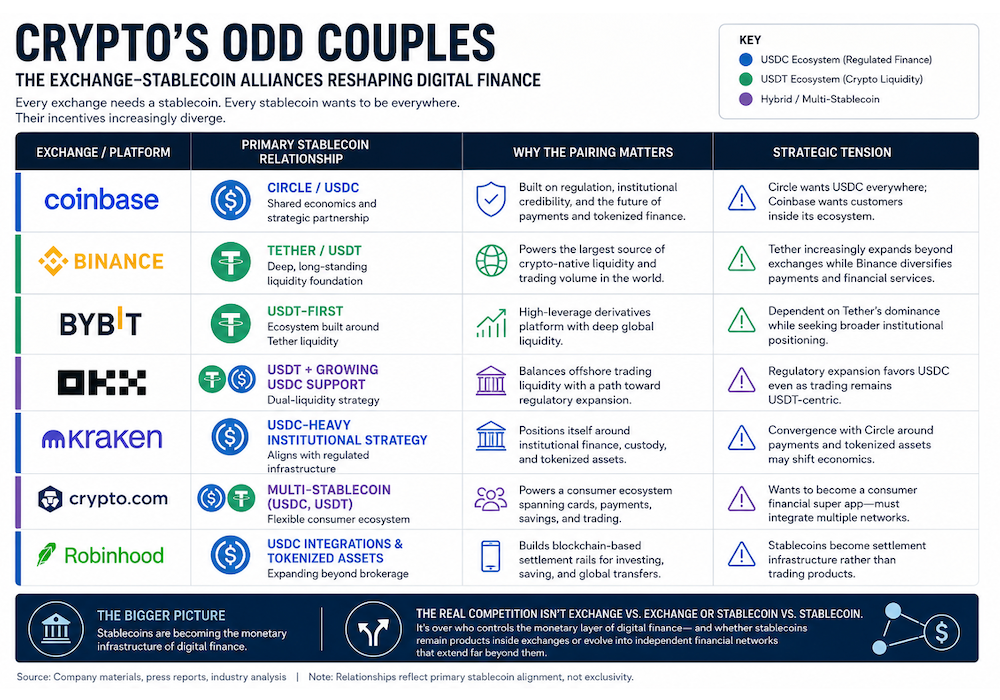
In 2018, for example, Coinbase and Circle co-founded the USDC stablecoin and positioned the new token as a regulated alternative to Tether’s USDT asset. The crypto firms’ incentives were unusually aligned because Coinbase shared directly in USDC’s economics and still does. Reserve income generated by USDC is a meaningful contributor to Coinbase’s profitability, and over time the USDC stablecoin transformed from a customer acquisition tool into one of Coinbase’s most important revenue streams.
Coinbase, however, is also one of the OUSD consortium members. Circle is not. Fast forward to today, and Coinbase’s share price is up around 10% on the news of the OUSD initiative, while Circle’s fell nearly 16% on Tuesday after the announcement.
See also: Europe’s Crypto Reset Begins: Who’s In, Who’s Out Under MiCA
The Alliances That Solved Crypto’s Biggest Problem
Since the start of cryptocurrency’s commercial existence, exchanges and stablecoin issuers built one another’s businesses. Exchanges supplied customers, liquidity and distribution. Stablecoins supplied the digital dollars and token assets that allowed crypto markets to function around the clock without relying on the traditional banking system. The result was an exchange-stablecoin ecosystem composed of distinct geopolitical and economic alliances, much like card networks and issuing banks or cloud providers and enterprise software companies.
By creating blockchain-based representations of dollars, issuers such as Circle and Tether provided a settlement asset that moved at internet speed. Exchanges suddenly had a common unit of account that allowed traders to move liquidity instantly across platforms without touching the banking system. The arrangement created a remarkably efficient economic flywheel. Every new exchange listing expanded stablecoin adoption. Every additional stablecoin increased trading efficiency. Liquidity attracted more traders, who created more demand for digital dollars, which in turn attracted more exchanges.
Together, exchanges and stablecoins built much of modern crypto’s financial architecture. But partnerships born from necessity rarely remain static once industries mature. Today, stablecoins increasingly sit at the center of an expanding financial network connecting banks, payment companies, treasury platforms, merchants, enterprise software and capital markets. In many ways, crypto is replaying the history of banking, where whoever owns the deposit (or digital dollar) ultimately has more durable economics than whoever facilitates the transaction.
We’d love to be your preferred source for news.
Please add us to your preferred sources list so our news, data and interviews show up in your feed. Thanks!
Each “odd couple” historically made the other more valuable and each depended on the other to grow. Today, however, and some of crypto’s closest commercial partners are gradually becoming one another’s biggest long-term competitive threats.
See also: Crypto Stopped Fighting Banks and Started Copying Them
Crypto’s Most Important Power Struggle Is Between Partners, Not Rivals
The first generation of stablecoins derived much of their utility from trading activity. Today’s stablecoins increasingly derive their value from moving money.
Circle’s strategy reflects that evolution. The company now talks less about cryptocurrency markets and more about cross-border payments, treasury management, supplier settlement, programmable finance and institutional liquidity. Its partnerships involve banks, payment processors, software companies and financial institutions rather than simply cryptocurrency exchanges.
Tether has pursued a different path but arrived at a similarly broader ambition. While USDT remains the dominant source of liquidity across global crypto markets, particularly in emerging economies, the company has steadily expanded into cross-border commerce, sovereign adoption initiatives, infrastructure investments and digital dollar access outside traditional banking systems.
The exchanges see the same future. Trading remains enormously profitable during bull markets, but it is also cyclical. Infrastructure businesses produce steadier economics.
Coinbase’s investments in Base, wallets, institutional custody, merchant payments and developer services reflect an effort to become much more than a venue where customers buy and sell digital assets. Kraken has expanded into payments, custody and tokenized financial products. Binance continues building merchant services, payments infrastructure and broader financial offerings that extend well beyond exchange activity.
These investments are often described as diversification. They are better understood as vertical integration. If stablecoins increasingly become the infrastructure layer for digital finance, exchanges want to remain indispensable after the trade is complete.
After all, trading fees are earned once while financial infrastructure earns revenue continuously. And the industry’s next competitive map appears to be extending outside crypto altogether.



 Add as Preferred Source