The PYMNTS Intelligence report “Locking in Loyalty: Securing Top-of-Wallet Status in a Changing Economy” shows that financial institutions (FIs) are being pushed to rethink rewards, moving away from one-size-fits-all programs toward personalized, real-time benefits that meet consumers in the moment.
 Economic pressures and rising competition from FinTechs and challenger banks are rewriting the rules. Once considered an add-on, loyalty programs are now a strategic necessity. For consumers, they are a way to help manage spending and gain some firepower, in terms of cash back and other rewards, to get the goods and services that they want to buy.
To stay relevant, FIs must combine seamless payments, strong security and data-driven personalization. Among these priorities, rewards, especially those delivered instantly and tailored to consumer behavior, are a decisive differentiator.
We’d love to be your preferred source for news.
Please add us to your preferred sources list so our news, data and interviews show up in your feed. Thanks!
Key findings on personalization and real-time redemption include:
- Sixty percent of consumers say they want rewards customized to their relationship with card providers, yet only 45% are satisfied with the options they currently have.
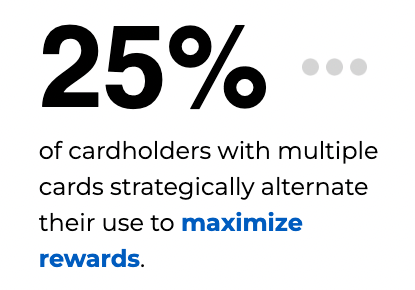
- More than 25% of cardholders with multiple cards rotate use to maximize rewards, underscoring how incentives directly influence card choice.
- Flexible redemption is critical, as consumers increasingly prefer cash equivalents or gift cards, while real-time redemption at checkout increases spending and reduces liability for unredeemed points.
This evolution means loyalty is no longer built on static catalogs of airline miles or delayed credits. Instead, personalization and immediacy are becoming nonnegotiable.
Examples of real-time rewards include a coffee discount delivered just as a cardholder passes the café or rent payments turned into points. These types of rewards signal that a bank understands its customers’ daily financial lives. Partnerships, such as FIS’s work with Bilt on real-time redemption, show how institutions are racing to rewire their rewards to capture attention and loyalty.
Security Is Critical
Beyond personalization, the report also emphasizes that seamlessness and security remain table stakes and help ensure peace of mind when using these card features. Consumers demand frictionless experiences across digital and physical channels, with 23% citing ease of use as the top reason for choosing a card. Security concerns are equally critical, as 59% of consumers in the United States fear banks aren’t doing enough against evolving fraud threats, and 69% would switch providers if they perceive weak protections.
Finally, the study notes that targeted, data-driven marketing is essential for FIs seeking to hold top-of-wallet status, especially among young demographics who now take their financial cues from social platforms.
Rewards may be the hook, but more broadly, FIs that fail to integrate personalization, immediacy and trust risk being rotated out of consumers’ wallets.



 Add as Preferred Source