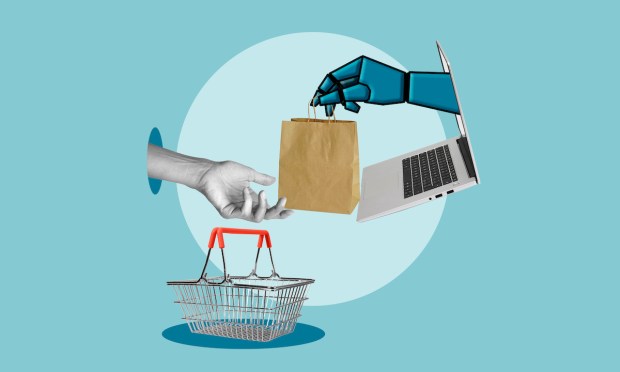
Artificial intelligence (AI) shopping agents are forcing online retailers to reconsider how they attract customers, authorize payments and protect their relationships with shoppers, as technology companies increasingly insert themselves between merchants and buyers.
Retailers are responding differently. Amazon is blocking prominent outside agents, Target is permitting approved providers, and Walmart is partnering with AI companies to attract customers. Their approaches reflect a broader commercial challenge retailers face. Agents could generate sales while shifting control over transactions and customer information toward the platforms operating them, according to The Wall Street Journal.
Agents including Meta’s Muse and OpenAI’s dots are helping consumers choose purchases, bid in auctions, book travel and order groceries. By handling those tasks, they could spare shoppers some of the work that digital services previously transferred from businesses to customers.
For merchants, however, that convenience creates new operational demands. Retailers have spent years learning to attract shoppers through search engines and social media. Serving software acting for those shoppers requires different methods, while offering less visibility into the people behind the purchases.
Unlike customers whose clicks and searches reveal preferences, third-party agents may provide limited information about whom they represent. That makes it harder for merchants to understand purchasing decisions or anticipate future demand.
Different AI models also assess products differently, complicating efforts to influence recommendations.
“That makes it more complicated for marketers, but that also makes it very interesting,” Jim Yu, chief executive of search and AI optimization company BrightEdge, told the Journal.
BrightEdge estimates that purchases through agents are increasing 43% monthly and have roughly quadrupled since April. Yet only about 3% of the eCommerce companies it works with allow agents to complete transactions for consumers, suggesting that merchant readiness remains limited.
We’d love to be your preferred source for news.
Please add us to your preferred sources list so our news, data and interviews show up in your feed. Thanks!
The implications extend beyond marketing. Purchase errors could increase merchandise returns and credit card chargebacks. “The question shifts from proving that a buyer is an authorized payer to proving that an agent has the authority to pay on the buyer’s behalf,” Federal Reserve Governor Christopher Waller said in a recent speech cited by the Journal.
That distinction makes delegated purchasing authority a central control issue as agent transactions expand.
Amazon has responded by banning Muse and dots from shopping on its platform. Blocking them protects its direct access to consumers, advertising business and customer data. Its established Prime relationships also give shoppers a reason to continue buying directly even when their preferred agent cannot participate.
Rosenblatt Securities analyst Scott Devitt argued in a recent note that Amazon’s control over product discovery, transactions, fulfillment and data leaves it little incentive to surrender part of that chain to another company.
Other retailers see greater opportunity in outside distribution. Target permits agents from an approved list of companies, adopting a selective approach to access.
Walmart has worked with OpenAI and Google to increase traffic through AI tools. Its U.S. chief executive, David Guggina, said last month that those efforts were attracting new customers and producing “fantastic” conversion rates.
Businesses are also developing their own agents, such as DoorDash’s Ask, the Journal noted. When operated by the merchant or delivery platform, an agent can draw on better information about inventory, promotions and fulfillment, while helping resolve problems.
DoorDash Chief Executive Tony Xu emphasized in August that the company understands product availability and can manage pickup and delivery. Consumers ultimately care about receiving their purchases, he said.
These competing strategies leave retailers balancing additional sales against reduced control. If third-party agents become a dominant shopping channel, their operators could collect subscription revenue, advertising income or transaction fees. For merchants, adapting will require decisions about access, reliable fulfillment and payment authority as well as how to remain visible when software chooses where consumers spend.


 Add as Preferred Source