Retailers found a way to get inflation-weary Americans to buy in June. The question is how much it cost them.
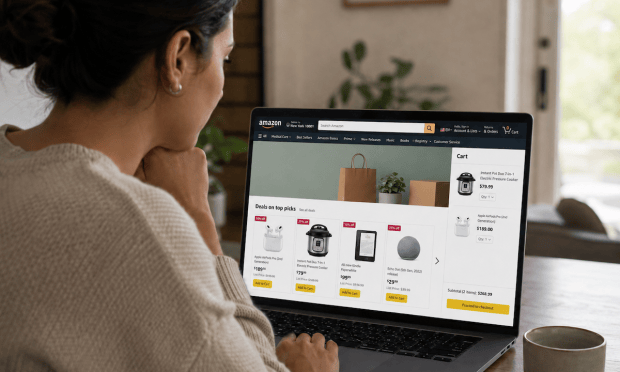
Amazon’s four-day Prime Day pulled into late June and was quickly matched by Walmart, Target and other chains. Still, Amazon’s discount push appears to have cleared the most basic hurdle: It grew. U.S. online spending across retailers during the June 23-26 window topped $26.4 billion, up 9.3% from a year earlier and narrowly above pre-event estimates of around $26 billion. The opening day alone generated $8.3 billion, the biggest U.S. eCommerce day of 2026.
The less comfortable read of the summer retail season heading into the July Fourth holiday, however, is that shoppers are still spending their hard-earned money with one hand on the brakes.
Read more: Amazon and Walmart Battle to Become Retail’s Most Powerful Data Broker
Retail’s Next Winner Won’t Look Like Just a Retailer
The Amazon-Walmart rivalry has traditionally been easy to narrate. Amazon owned eCommerce while Walmart owned the store. Amazon had search, selection and delivery speed. Walmart had grocery, price authority and the weekly household trip.
We’d love to be your preferred source for news.
Please add us to your preferred sources list so our news, data and interviews show up in your feed. Thanks!
But the latest retail headlines this week point to a more complicated and more consequential contest, one defined by shopper confidence and macro realities. The world’s largest retail rivalry is no longer about whether consumers shop online or in stores. It is about which company gets to decide what shopping becomes when the distinction stops mattering.
The Big Picture
- Amazon became the largest U.S. retailer by gross merchandise value in 2025.
- The Fourth of July sales story is not really about holiday discounts. It is about which retailer can turn bargain-hunting into repeat behavior.
- Amazon is using deals, AI, Alexa and price transparency to make shopping feel smarter and more automated.
- The non-obvious trend: Amazon is not just discounting products. It is training consumers to delay purchases until Amazon-defined deal windows.
- Walmart is using groceries, fuel, physical stores and energy infrastructure to make membership feel more essential to household economics.
- The non-obvious trend: Walmart is moving the subscription tet-a-tet out of streaming and shipping and into the gas tank.
PYMNTS Intelligence has put hard numbers around retail’s ongoing shift. As of the first quarter of 2026, Amazon held 9.3% of U.S. consumer retail spending, up from 8.6% a year earlier, while Walmart held 7.8%, unchanged from the prior year. Amazon led in 4 out of 7 major retail categories: sporting and hobby goods, music and books, electronics and appliances, furniture and home furnishings, and clothing and apparel. Walmart’s strength remained concentrated in food and beverages and auto parts.
Read more: AI Can Pick the Shoes but Amazon Still Moves the Box
The Week’s Headlines Show Retail Competition Moving Up the Stack
The question for both Walmart and Amazon is no longer which company can sell more goods but which company can control the systems that determine what consumers see, compare, buy, receive, return and reorder.
The headlines this week show how their strategies are playing out:
- Alexa is being repositioned from voice assistant to shopping confidence layer. Amazon expanded Alexa for Shopping to show 30-, 90- and 365-day price histories, and says more than 50 million customers have checked price history since the feature launched in 2024.
- Amazon is building the device-level infrastructure for AI-mediated shopping by designing custom AI chips for its own Echo and Fire TV devices.
- Walmart signed a long-term nuclear power purchase agreement with Constellation for about 176 MW of wholesale supply, including 30 MW of expanded capacity, with two 15-year terms beginning in 2029 and 2030.
- Elsewhere in retail, Kroger agreed to buy Giant Eagle for $1.65 billion, adding 197 stores, 11 standalone pharmacies and about $9 billion in annual sales. Kroger is buying regional relevance before national platforms make regional grocers less defensible.
Wall Street Is Pressuring Both Models
- Amazon stock lost 12% in June as investors worried about AI spending, including management’s plan for $200 billion in capital expenditures this year
- Walmart’s stock has also suffered recent declines related to investor concerns around slowing U.S. comparable sales and questions about margin strategy.


 Add as Preferred Source