However, the biweekly paycheck cycle, long seen as a given of employment, is beginning to unravel.
PYMNTS Intelligence’s September Money Mobility Tracker®, “Instant Loyalty: The Growing Necessity of Earned Wage Access Amid Uncertainty” a collaboration with Ingo Payments, reveals that a growing share of employees, especially young ones, are no longer content to wait two weeks for money they’ve already earned.
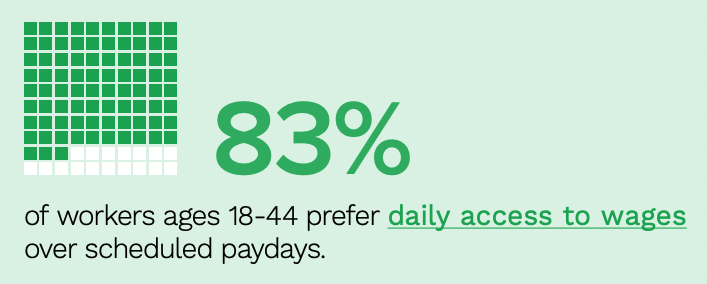 In a climate of tariffs, inflation and rising living costs, the timing of pay has turned from a back-office routine into a frontline competitive advantage. The report finds that 83% of workers aged 18 to 44 prefer daily access to wages over fixed paydays.
With the cost of essentials climbing and consumer debt at record levels, liquidity, or the speed at which workers can access the fruits of their labor, has become central to household stability. Financial pressure is reshaping the labor market itself. Employees now shop for jobs not only by hourly rate or benefits but by the immediacy of pay, making earned wage access (EWA) one of the most talked-about workplace innovations of the past few years.
A Financial Lifeline Becomes a Talent Strategy
EWA, often called instant payroll or on-demand pay, was once promoted mainly by FinTech startups catering to gig workers. It has since spread into mainstream employment.
We’d love to be your preferred source for news.
Please add us to your preferred sources list so our news, data and interviews show up in your feed. Thanks!
The shift is being driven by both sides of the labor equation. Workers under strain from inflation and housing costs value liquidity; employers facing stubborn churn in fields like healthcare, retail and manufacturing are discovering that fast pay can be as powerful as higher pay. The report shows that firms offering EWA see turnover drop by as much as 37% and applicant interest double. In an era of worker mobility, that’s an edge that cannot be ignored.
If instant access to wages sounds like a luxury, the data suggests otherwise. The report reveals that 85% of freelancers report being paid late at least some of the time, with women disproportionately affected. Female freelancers face late payments 31% of the time versus 24% for men. Even among traditional employees, 53% have experienced payroll issues, and nearly a quarter cite late payments specifically.
Such delays are more than inconveniences. Many workers live paycheck to paycheck; a single late deposit can cascade into overdraft fees, missed rent or skipped utility payments. Workers often interpret late pay as a sign of deeper organizational instability, eroding trust in management and morale across teams. That erosion can translate directly into higher absenteeism, reduced productivity and turnover.
Read the report: Instant Loyalty: The Growing Necessity of Earned Wage Access Amid Uncertainty
In this context, timely pay is a matter of dignity and reliability, qualities that influence how employees perceive their employers. The rise of EWA suggests that workers no longer view waiting for payday as an immutable fact of employment; they see it as an avoidable friction in the age of instant everything.
The embrace of on-demand pay reflects the broader consumer expectation of immediacy. Just as people have grown accustomed to streaming movies or ordering food for delivery within minutes, many now expect wages to flow as seamlessly. The report reveals that nearly 60% of EWA users say it helped them avoid borrowing from friends and family, 40% say it prevented them from paying late fees, and nearly one-third say it kept them from incurring overdraft charges.
The technology has evolved to support this shift. Modern EWA platforms integrate directly with payroll and human resources software, tracking earnings in real time and enabling instant transfers. Most employers set caps, often a percentage of accrued wages, to prevent over-withdrawal, but workers typically use the feature responsibly.
The lesson for employers? In an economy where financial stress is widespread and mobility is high, the timing of pay can matter as much as its amount.



 Add as Preferred Source