For banks, connecting to real-time payments was the entry point. Making those payments useful requires considerably more work inside the institution, from back-office processing and account posting to deciding when a payment should travel over an instant rail at all.
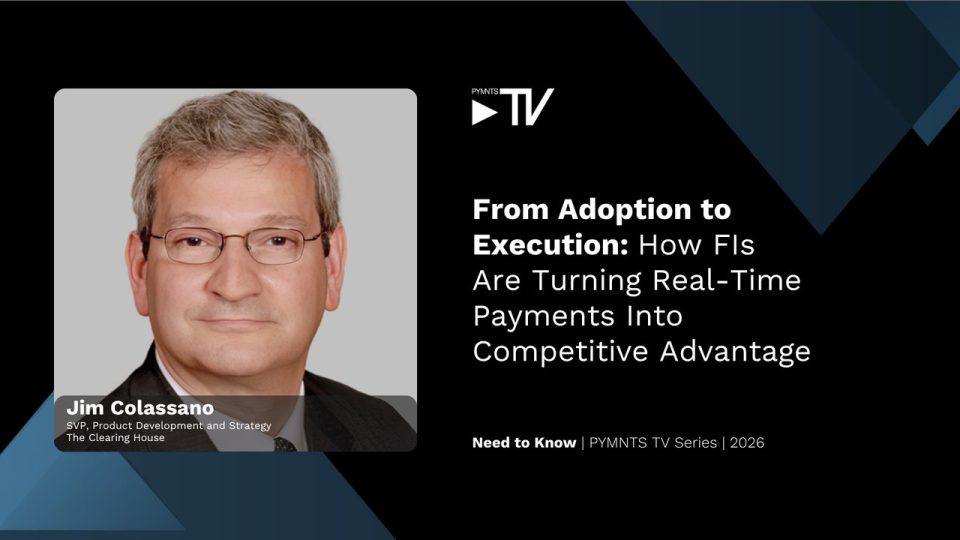
That is the execution problem now confronting financial institutions as real-time payments move beyond network access, according to Jim Colassano, senior vice president of product development and strategy at The Clearing House (TCH).
Colassano drew a clear line between participation and execution. Every bank joining the RTP® network must allow customers to receive instant payments and have immediate access to those funds around the clock. He described that as the “baseline execution” required of participants. The larger product task begins with origination.
“The strategic element comes into play as they enable the ability for those clients to originate RTP payments through their various digital access channels,” Colassano told PYMNTS, “and when they start developing products and use cases that leverage the expansive capabilities of the RTP network.”
In the past, connectivity proved an obstacle for early participants, Colassano said, because banks had to connect their demand deposit platforms to the network. Technology providers can now provide that connection across large numbers of banks. The harder operational question concerns systems and processes designed for payment rails that have operated differently for decades.
Bank back offices have long been organized around batches of transactions settling several times during a business day, with workflows built to handle exceptions afterward. RTP processes each transaction individually, with immediate clearing and settlement 24 hours a day.
“The RTP network and instant payments generally breaks that model because every individual transaction now gets cleared and settled individually, instantaneously, 24 hours a day,” Colassano said.
Monitoring applications, data systems and other controls that a bank consults before posting a transaction must also be capable of operating in real time, he said. The technical work has become more familiar as banks and technology providers have accumulated experience, but institutions still must alter processes built around legacy rails.
From Network Access to Customer Experience
For customers, the underlying payment infrastructure is largely beside the point. Colassano said the experience itself carries more weight, particularly for consumers.
One of the earliest broad use cases has been moving money between accounts owned by the same consumer or business, including accounts held at different financial institutions or in wallets. It is a straightforward transaction, but one that makes the properties of real-time payments immediately apparent.
“They can see the money moving out of their one account, and then within the blink of an eye, they can see the money coming into the other account and being available to them,” Colassano said. “That’s almost visceral to clients.”
Account-to-account transfers also provide a foundation for more specialized uses. Speed is only one characteristic available to product developers. Payment finality, confirmation and 24/7 availability can address situations in which the recipient needs certainty that money has arrived before a transaction can proceed.
We’d love to be your preferred source for news.
Please add us to your preferred sources list so our news, data and interviews show up in your feed. Thanks!
Colassano pointed to the sale of a vehicle as one example. Driveway.com, he said, can purchase a car at a customer’s home and issue an instant payout as the vehicle leaves the driveway. The commercial problem is specific: The seller wants the money, and confirmation that it has arrived, when the asset changes hands.
Similar requirements can arise with early wage access and gig work, where payment timing is linked closely to the completion of work, as well as in B2B payments. The Clearing House raised the RTP network transaction limit to $10 million last year, and Colassano said business activity has followed. For larger transactions, confirmation of receipt, 24/7 sending capability, and settlement finality can carry as much significance as speed.
Execution, however, does not mean routing every eligible transaction onto the RTP network.
Colassano said The Clearing House did not introduce the RTP network with the expectation that it would displace ACH, wires or other established rails. Instead, instant payments addressed gaps where existing systems did not readily support transactions outside normal operating hours or situations requiring immediate and final settlement.
That leaves banks with a broader product-design question: How much of the choice of rail should customers have to make themselves?
Colassano said some banks are organizing payments around the outcome a customer wants. A payment that must arrive immediately, be final, and operate around the clock can be directed to the RTP network. A non-urgent payment may be better suited to ACH.
“The banks who are getting it better, or doing it well, are not making it necessary for the customer to understand the rail,” he said, “but having the customer tell them what they want that payment to do, and what are the priority attributes of that payment, and letting the bank route it to the appropriate rail.”
That approach also changes how banks can think about their payment infrastructure. The RTP network, ACH, wires and FedNow need not be separate products presented to customers as separate technical choices. They can operate as alternatives behind a payment service, with the institution selecting a rail according to timing, finality and other requirements.
“What we see in terms of the evolution of the market [is] looking at payment processing holistically and no longer as a silo,” Colassano said.
Watch the full video of Jim Colassano, senior vice president of product development and strategy at The Clearing House, discussing:
- How financial institutions are handling the operational demands of real-time payments,
- What banks have learned as deployment has broadened
- How payment choice can be managed behind the customer experience rather than presented as another layer of complexity.

 Add as Preferred Source