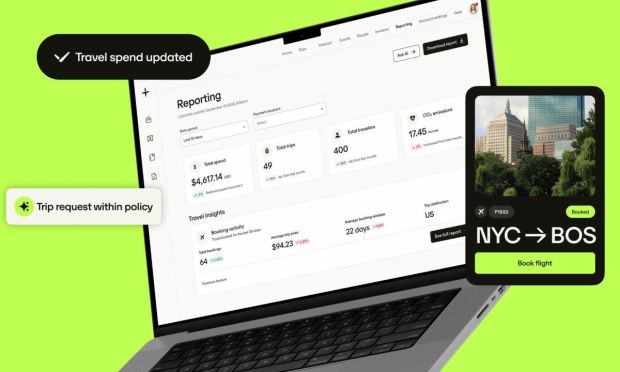
The expansion is aimed at capitalizing on a market where customers are already spending more than $1 billion each year on work travel and team events, London-and-Boston-headquartered Perk said in a Tuesday (Sept. 15) news release.
“US companies are spending more on travel every year, but the tools to manage it aren’t keeping up,” said Avi Meir, Perk’s co-founder and CEO.
“We’ve built one AI-native travel and spend platform with agentic capabilities for how American companies actually work.”
The announcement follows the launch of Perk Spend in Europe, where up to 40% of new deals are for the company’s combined travel and spend offering, the release said. Perk, formerly known as TravelPerk, says it expects the same in the U.S., a region which already brings in 30% of new business globally.
We’d love to be your preferred source for news.
Please add us to your preferred sources list so our news, data and interviews show up in your feed. Thanks!
Perk Spend offers features such as bring your own card (BYOC), letting customers use an existing corporate card program while still connected to Perk Spend, “fully integrated with Perk Travel, so every transaction reconciles through one system,” the release said.
The company also plans to soon introduce a corporate charge card in the U.S. that lets customers “manage spend controls, earn cashback, and pay securely around the world,” the release added.
“Finance leaders don’t want to choose between control and flexibility, they want both,” said Nikita Miller, Perk’s president of product and technology. “Perk Spend gives them real-time visibility into every dollar spent, while letting employees keep the corporate card, the personal card, or the points they’ve already earned.”
PYMNTS wrote earlier this year that while business travel is recovering, the idea that demonstrates the continued importance of face-to-face interactions in a digital world is “correct, but incomplete” one.
“What makes business travel particularly significant in 2026 is not the volume of trips being taken. It is the nature of those trips,” the report said.
“Organizations are traveling with greater intention, focusing on activities that create measurable business value. Those journeys increasingly revolve around supplier relationships, customer acquisition, market expansion and strategic partnerships — the very activities that generate future trade and payment flows.”
That’s backed up by PYMNTS Intelligence/Mastercard research, which showed that 57% of U.S. small to medium-sized businesses (SMB) source goods or production inputs from overseas suppliers, which makes cross-border payments an increasingly routine part of daily operations.


 Add as Preferred Source