For shoppers with the most cash to burn, PYMNTS Intelligence data reveal, store-specific card-linked rewards go the longest way toward driving spending.
By the Numbers
The report “Card-Linked Offer Growth Hinges on First-Time Users,” a PYMNTS Intelligence and Banyan collaboration, drew from a February survey of more than 2,100 U.S. consumers to better understand how and why they started using card-linked offers.
The results revealed that 41% of consumers who make more than $100,000 a year prefer to earn rewards on overall spending at a specific store, while only 18% prefer discounts on specific products, 30% are indifferent and 11% are unsure.
We’d love to be your preferred source for news.
Please add us to your preferred sources list so our news, data and interviews show up in your feed. Thanks!
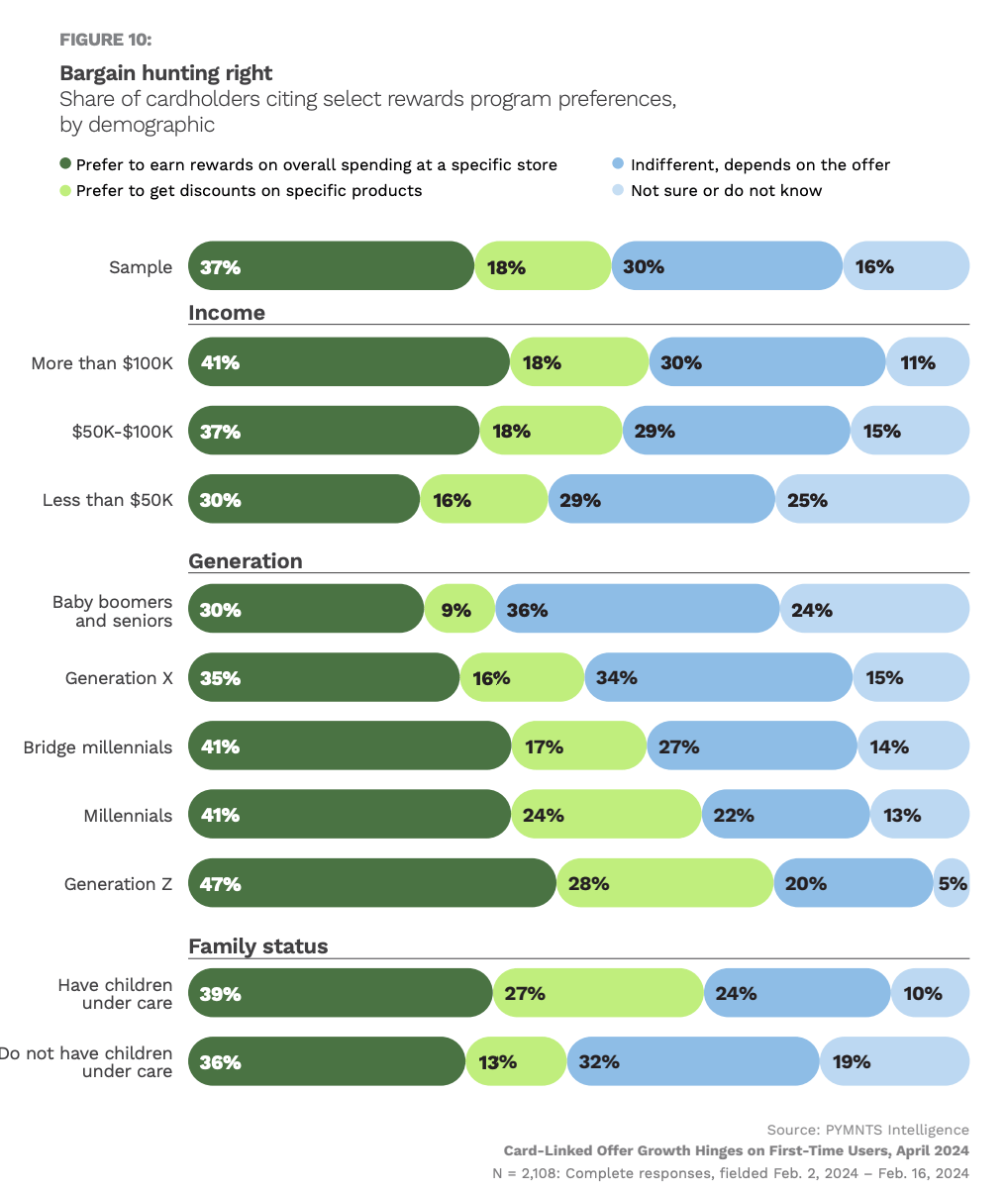
These figures showed that higher-income shoppers are likelier than the average consumer to want store-specific rewards, as only 37% of the sample overall exhibited the same preference.
The study also found that younger consumers — namely, Generation Z shoppers, millennials and bridge millennials — were disproportionately likely to want store-specific rewards. As such, by offering card-linked rewards, retailers have a good chance of winning the spending of wealthier and younger shoppers.
On the Other Hand
Conversely, there may be drawbacks for retailers in offering card-linked rewards across their offerings rather than focusing on item-specific perks.
“I think card-linked offers have been a rather blunt instrument in a retailer’s marketing toolkit,” Jehan Luth, CEO of Banyan, told PYMNTS in a 2022 interview. “One of the biggest reasons it’s a blunt instrument is because as a retailer, I cannot drive traffic to certain items. Instead of traditional loyalty offerings that may not be consumer-personalized, the overlaying of SKU-level data or item-level data in rewards and offers makes card-linked offers a much more versatile and powerful tool in the toolkit for retailers.”
The space may be due for a change soon, as the Consumer Financial Protection Bureau (CFPB) investigates the way that credit card rewards programs are designed following a rise in consumer complaints about such programs.



 Add as Preferred Source