A shortage of ambition is not what holds back middle-market companies in the United States. Cash flow is.
Businesses generating between roughly $1 million and $50 million in annual revenue often find themselves caught between two banking worlds. They have outgrown the products and underwriting models built for small businesses, yet they have not fully entered the commercial banking environment designed for larger enterprises. The result is a funding gap that can slow expansion even as demand for their products and services continues to rise.
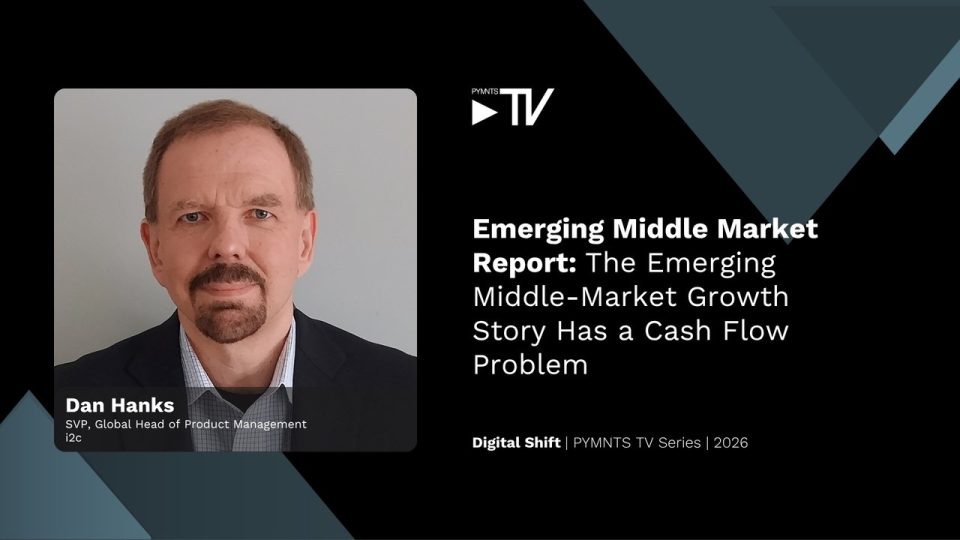
Dan Hanks, senior vice president and global head of product management at i2c, said he believes the challenge stems less from the companies themselves than from the way financial institutions are organized.
Asked during a lightning round with PYMNTS to describe the emerging middle market, Hanks said: “Fast growing. These firms don’t have a growth problem, but they have a problem with banks supporting the growth,”
Many of these businesses are adding customers, expanding product lines and entering new markets. What often lags behind is the financial infrastructure needed to support these moves.
“It’s really about supporting that growth from small business to commercial,” size, Hanks said.
That transition is where many banks lose sight of valuable customers, he said.
Banks typically separate small business and commercial banking into different organizations with different underwriting practices, different product sets and, in many cases, different technology platforms. Small business lending often centers on the owner’s personal credit profile. Commercial banking relies on corporate financial statements, cash flow analysis and operating performance.
Companies that fall between those two models frequently find themselves without a natural home.
Founders often resort to personal credit cards and personal loans because traditional business financing no longer matches their needs, Hanks said. While that approach may keep operations moving, it introduces long-term complications. The very activity supporting business expansion may never become part of the commercial credit history future lenders evaluate.
When Banks Stop Sharing Data, Growth Stops
A large share of fast-growing companies report that they have access to sufficient credit, yet many still miss expansion opportunities because financing does not arrive in the right form or at the right moment.
Traditional underwriting models are comfortable with predictable performance. They are less comfortable evaluating companies growing 30%, 40% or 50% annually. That caution is understandable, Hanks said, but it also leaves banks relying on processes that do not always reflect the trajectory of their own customers.
We’d love to be your preferred source for news.
Please add us to your preferred sources list so our news, data and interviews show up in your feed. Thanks!
The answer is not simply approving more loans. It is making better use of the information banks already possess, Hanks said. Too often, however, that history remains trapped inside separate business units.
The same fragmentation shapes what banks hear from clients. Middle-market companies consistently look for financial partners that can move with them rather than force them to restart relationships every time they reach another stage of growth, Hanks said.
Technology remains part of the challenge.
“Banks tend to have a legacy technology platform they might have had for many decades,” Hanks said. “Often that’s not flexible and fast enough to support these businesses.”
Even where the desire exists to serve these customers better, disconnected systems can make coordinated underwriting and account management difficult. A bank may understand the opportunity, yet lack the infrastructure needed to provide a seamless transition from small business banking into commercial banking.
That is where competitive advantage begins to shift, Hanks said. Middle-market firms are not waiting for the financial system to catch up. They continue expanding, adopting more sophisticated operating systems and pursuing new markets. The banks that retain those relationships will be those capable of adapting alongside them.
Banks should view these companies as long-term relationships rather than separate customer segments divided by organizational boundaries, Hanks said.
“You can think of it as a growth opportunity for your bank, or you can think of it as a defensive opportunity,” Hanks said.
“If you don’t achieve that growth with them,” he said of middle-market firms, “they’ll leave for somewhere else.”
Watch the interview with Dan Hanks to learn more about:
- Why the move from QuickBooks and spreadsheets to ERP systems often marks a turning point for growing companies.
- How banks can use existing customer data to smooth the transition from small business banking to commercial banking instead of forcing clients to start over.
- Why the organizational structure inside financial institutions may matter as much as lending capacity when serving middle-market firms.
For all PYMNTS B2B coverage, subscribe to the daily B2B Newsletter.


 Add as Preferred Source