Credit unions have a challenge that is more specific than simply getting members to use their cards more often.
The July 2026 edition of “Credit Union Innovation Readiness: Consumers Trust Credit Unions but Don’t Always Reach for Their Cards,” a PYMNTS Intelligence report produced in collaboration with Velera, surveyed 14,218 U.S. consumers and 3,529 U.S. small and medium-sized businesses (SMBs).
PYMNTS previously examined how making a credit union card top of wallet is associated with stronger deposit growth among both consumers and SMBs. The report also reveals where credit union cards are actually capturing spend, where they are losing it and what members say influences their card choice.
5 Things to Know:
1. Credit unions have an edge on several essential expenses
Credit union cards outperform national bank cards in several recurring and essential consumer categories. Among cardholders, 23% use their credit union card for rent or mortgage payments, compared with 16% of national bank cardholders using their national bank card.
Credit unions also lead in utilities, 37% versus 34%; mobile phone and home internet, 35% versus 33%; groceries, 58% versus 57%; and basic healthcare, 18% versus 16%.
2. Travel is the largest discretionary weak spot
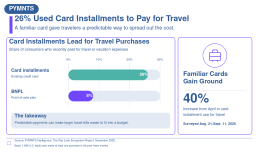
The pattern reverses when consumers make more discretionary purchases. Credit union cardholders are 45% less likely than national bank cardholders to use their respective cards for travel, 11% versus 20%.
Credit union cards also trail in electronics, 11% versus 17%; retail, 16% versus 20%; subscriptions, 21% versus 25%; and restaurants, 42% versus 47%.
We’d love to be your preferred source for news.
Please add us to your preferred sources list so our news, data and interviews show up in your feed. Thanks!
3. Credit union SMB cards win in some specialized business expenses
The business spending picture is different. Credit union SMB cards lead national bank cards in construction and contracting, 20% versus 16%, and renovation or space expansion, 11% versus 9%.
Those advantages are most pronounced among smaller businesses and outside major metropolitan markets. The construction advantage is widest among firms with less than $250,000 in annual revenue, while the renovation advantage is greatest among rural and small-town businesses.
4. National banks capture more routine SMB operating spend
Credit unions fare less well in several higher-volume business categories. National bank cards lead credit union cards for inventory purchases and basic operating costs, both 54% versus 49%.
National banks also lead in marketing and promotion, 41% versus 34%, and non-inventory product purchases, 39% versus 35%. The data suggests that winning specialized expenses does not necessarily translate into capturing the purchases businesses make routinely to operate.
5. Consumers and SMBs point to different card gaps
Among credit union consumers with any payment card, 44% cite incentives and rewards as a card-choice factor, compared with 32% of those whose credit union card is already top of wallet.
SMBs put different requirements near the top. Lower rates and fees are cited by 41% of credit union SMB cardholders, while roughly one-third cite adequate credit limits. SMB cardholders overall are also more likely than those already using their CU card as top of wallet to cite cash back, 31% versus 25%, and budgeting and expense tools, 24% versus 17%.
For credit unions, the report therefore identifies two different card-product challenges: competing for discretionary consumer transactions and capturing a larger share of the everyday expenses running through small businesses.



 Add as Preferred Source