Accounts payable technology is being judged on how well it connects to the systems businesses already use, giving developers, IT teams and implementation specialists a larger role in payment-platform decisions.
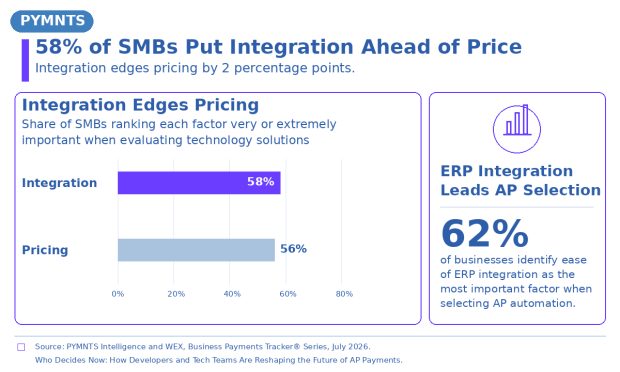
The PYMNTS Intelligence Tracker “Who Decides Now: How Developers and Tech Teams Are Reshaping the Future of AP Payments” found in July that 58% of small- to medium-sized businesses rank integration as very or extremely important when evaluating technology solutions, compared with 56% that said the same about pricing. The two-percentage-point difference puts integration slightly ahead of cost in the evaluation process.
We’d love to be your preferred source for news.
Please add us to your preferred sources list so our news, data and interviews show up in your feed. Thanks!
The Tracker linked that priority to the growing complexity of embedded payments. As payment capabilities connect more deeply with enterprise software, buyers must consider API quality, implementation and whether a platform can operate inside the existing technology stack without creating new manual work.
Key findings from the Tracker:
- ERP integration was a leading AP requirement, as 62% of businesses identified ease of such system integration as the most important factor when selecting an AP automation solution. The finding put compatibility with core financial systems directly into the buying decision.
- Implementation carried the same weight as ROI for many buyers. Easy integration with existing systems, an easy implementation process and proven return on investment each ranked as top AP automation adoption factors for 40% of organizations. Workflow efficiencies followed at 37%, showing that deployment has become part of the business case rather than a technical step that comes later.
- Integration problems remained an obstacle after automation began. Difficulty integrating with existing systems was the top AP automation concern after cost, cited by 49% of finance leaders versus 50% for cost. Nearly 40% of respondents also identified integration and implementation concerns as their biggest challenge with autonomous AP initiatives.
The pressure was visible in day-to-day AP operations. Although 89% of organizations reported at least partial AP automation, half still processed more than 5,000 invoices per month through workflows that were not fully automated. Gaps between systems can require manual intervention and erode the efficiency that automation is supposed to deliver.
For AP providers, the data put APIs, documentation, testing environments and implementation resources alongside payment functionality in the product evaluation. For buyers, it gave finance and technical teams a shared reason to evaluate integration before a platform is selected.
For all PYMNTS B2B coverage, subscribe to the daily B2B newsletter.
At PYMNTS Intelligence, we work with businesses to uncover insights that fuel intelligent, data-driven discussions on changing customer expectations, a more connected economy and the strategic shifts necessary to achieve outcomes. With rigorous research methodologies and unwavering commitment to objective quality, we offer trusted data to grow your business. As our partner, you’ll have access to our diverse team of PhDs, researchers, data analysts, number crunchers, subject matter veterans and editorial experts.


 Add as Preferred Source