A debit processor migration can look successful on a project plan and still create problems at the checkout counter.
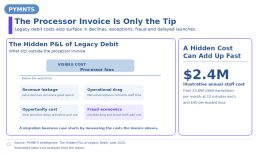
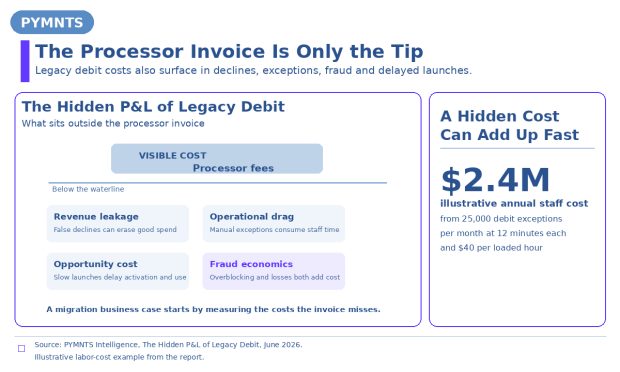
That’s one of the central findings in “The Hidden P&L of Legacy Debit: What Processor Migration Actually Costs, Saves and Breaks,” a June 2026 report from PYMNTS Intelligence and Galileo. The report finds that outdated debit infrastructure can create costs well beyond processor fees, including false declines, manual exception work, fraud losses and slower product launches. Modern platforms can improve real-time decisioning and card controls, but those gains depend heavily on how institutions handle the migration itself.
We’d love to be your preferred source for news.
Please add us to your preferred sources list so our news, data and interviews show up in your feed. Thanks!
The report focuses on an easily overlooked part of modernization: moving the debit program without disrupting the customer relationship. A processor conversion is a little like replacing an engine while the car is still moving. The technology has to change while payments, wallets, disputes and fraud controls keep working.
3 Areas Stand Out:
- Wallet tokens need their own migration plan. Customers using Apple Pay or Google Wallet expect their debit cards to keep working regardless of what happens behind the scenes. Institutions need to inventory tokens by wallet, network, BIN, requestor and status, then decide whether each token will be mapped, reissued or maintained through lifecycle management.
- Smaller migration cohorts can expose trouble earlier. The report recommends starting with lower-risk accounts, then moving into higher-usage, wallet-heavy and dispute-prone customer groups before broad conversion. That approach tests the new system against increasingly demanding real-world conditions.
- Conversion isn’t the finish line. Banks still need to watch authorization rates, false declines, fraud losses, exception volumes, complaints and wallet-token health. Parallel processing may run 30 to 60 days, but PYMNTS Intelligence says performance stability should determine when the old system comes off, rather than the calendar alone.
That discipline can make modernization more than a technology upgrade. Elsewhere, the report shows why the payoff can be meaningful. A modeled portfolio with 10 million monthly debit attempts and 0.50 percentage points of avoidable false declines would lose 50,000 good transactions. It also calculates that 25,000 monthly exceptions requiring 12 minutes each could consume $2.4 million in annual staff capacity.
Modern debit platforms can attack those costs while supporting instant issuance, real-time controls and faster product development.


 Add as Preferred Source