Artificial intelligence (AI) has become a mainstream consumer technology. But paying for it remains a much narrower habit. The consumers who do spend heavily on AI, however, are opening their wallets at levels that look less like entertainment subscriptions and more like business software budgets. The top 1% of consumer AI spenders averaged $903 a month in August, up 80% over the past 18 months, according to a Monday (Oct. 5) analysis from Andreessen Horowitz of YipitData spending data.
The median AI payer spent $25 a month, a figure that has changed little over time. The top 1% accounted for 19.5% of observed consumer AI spending, more than the bottom 50% combined at 16.6%, Andreesen Horowitz found. The figures come from YipitData’s U.S. consumer panels and reflect observed spending rather than total company revenue.
The share of U.S. consumers who had used generative AI for personal tasks in the past year reached 58.3% in August, up from 57.6% in June, according to the PYMNTS Intelligence October 2026 Consumer AI Benchmark Report.
Paying remains far less common. Just 4.5% of consumers in YipitData’s research had an active personal subscription to ChatGPT, Gemini or Claude in August, more than double the 2.1% a year earlier, Andreessen Horowitz found. Most subscribers stop at one service. Only 13% of consumers paying for one AI product also paid for another, the firm said.
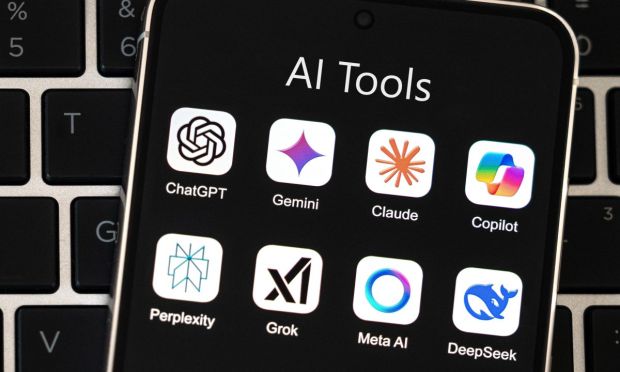
ChatGPT remains the dominant general-purpose AI product. It drew roughly twice as many web visits as Gemini in August and six times as many as Claude. On mobile, it has 2.5 times Gemini’s monthly active users and 14 times Claude’s. ChatGPT also has three times as many U.S. consumer paid subscribers as either rival.
Claude is competing on a different axis. It has passed DeepSeek and Perplexity in web traffic and overtook Gemini in U.S. consumer subscribers earlier this year, Andreesen Horowitz said. The two are now neck and neck after Google moved legacy paid users onto its AI plan.
Anthropic is also drawing consumers who spend more. The company has targeted business users with products including Claude Design, Code Review and Claude Science. About 7.3% of Claude’s consumer payers subscribe to Max, its most expensive individual tier, which starts at $100 a month, compared to 1.3% of Google’s payers and 1.1% of ChatGPT’s.
We’d love to be your preferred source for news.
Please add us to your preferred sources list so our news, data and interviews show up in your feed. Thanks!
Power Users Are Building AI Stacks
Heavy spenders disproportionately pay for automation and product-building tools such as n8n, fal, Manus and Nous Research’s Hermes Agent, Andreessen Horowitz noted. They also over-index on creative products including Figma, Higgsfield and HeyGen.
PYMNTS Intelligence sees a similar split in how intensely consumers use AI. Its classification weights each AI activity from one to three points by complexity and risk. Consumers scoring above 27 are power users, and those scoring five to 27 are mainstream users. Power users made up 7.2% of U.S. consumers in June, compared with 34.1% for mainstream users, PYMNTS Intelligence found.
The measures differ. PYMNTS Intelligence classifies consumers by what they do with AI, while YipitData tracks what they spend.
Most Used AI Apps Aren’t the Top Earners
Twenty-nine of the 50 largest AI vendors by observed consumer spending do not appear among Andreessen Horowitz’s top web or mobile products by usage, the firm found. Only seven companies appear across its web, mobile and spending rankings: ChatGPT, Claude, Suno, Perplexity, Photoroom, Canva and Notion.
Consumer AI still depends almost entirely on users paying directly. Of the 44 AI-native products in Andreessen Horowitz’s web ranking, 84% offer subscriptions and 64% charge for usage or additional credits, the firm found.
Consumer AI likely needs a new business model “or possibly, an old one,” Andreessen Horowitz Partner Olivia Moore wrote. Earlier consumer internet giants ran on advertising. Advertising generated 97.6% of Meta’s revenue and 73.2% of Alphabet’s in 2025, Andreessen Horowitz noted.


 Add as Preferred Source